
Quick Summary
Urban properties in Century City frequently trap fine outdoor particulates and allergens within sealed HVAC systems, necessitating specialized air quality sanitizing to restore healthy indoor environments. Pure Air Duct Cleaners, led by owner Larry Torres, provides professional air quality sanitizing in Century City by combining multi-stage HEPA negative-air mechanical extraction with hospital-grade antimicrobial treatments to eliminate deep-seated contaminants at the source. Homeowners and commercial property managers can contact Pure Air Duct Cleaners to request a free estimate and schedule expert air quality sanitizing services tailored to their specific ventilation system.
Air Quality Sanitizing – Pure Clean Indoor Air
Properties in dense urban areas often face indoor air quality challenges. In modern residential mid-rises and commercial high-rises, buildings are typically sealed tightly for thermal efficiency. When outdoor fine particulates and vehicle exhaust enter indoor spaces, they can become trapped. Over time, these particles can accumulate across duct linings, blower wheels, and evaporator coils, impacting airflow and indoor air quality.[2]
Professional duct cleaning services, such as Pure Air Duct Cleaners, provide specialized air quality sanitizing in the West Los Angeles area. Technicians pair negative-air mechanical extraction using commercial-grade vacuum and agitation equipment with targeted EPA-registered antimicrobials to eliminate physical contaminants at the source rather than masking problems with temporary sprays.
How Air Quality Sanitizing Works
Quick Answer: Air quality sanitizing combines source removal via HEPA vacuum systems with an application of an EPA-registered antimicrobial mist. This two-stage method strips settled dust, dander, and biological contaminants from supply lines, return plenums, and evaporator coils in residential and commercial properties.
Duct sanitization is not a single spray treatment. A proper protocol follows a strict order of operations: first, physically extracting deep-seated debris under negative pressure, then treating the sanitized surface area to neutralize remaining spores and bacteria.
What Is Included in a Full Treatment?
In tightly constructed homes and offices, fogging chemicals into uncleaned ductwork can cause issues. Liquid biocides can bind to existing dust layers, creating residue that may enter living spaces when the HVAC cycles on. A professional service like Pure Air Duct Cleaners avoids this by following three clear steps:
- Negative Air HEPA Extraction: High-powered vacuums place the duct network under continuous negative pressure, pulling loose dust, pet dander, and construction debris out of supply and return trunks without venting dust back into living areas.
- Air Handler and Coil Cleaning: Technicians physically brush and vacuum the evaporator coils, blower fan blades, drain pans, and supply plenums where moisture and buildup concentrate.
- EPA-Registered Antimicrobial Application: Once duct surfaces are stripped down to bare metal or clean liner, an ultra-low volume (ULV) botanical or EPA-registered antimicrobial mist is applied to eliminate remaining microbial spores and odors.
Why Mechanical Extraction Must Precede Duct Disinfection
Need air quality sanitizing in Century City?
We’re available now — call for a fast, free estimate.
Chemical biocides and botanical sanitizers are designed to contact clean, solid surfaces. If a service provider fogs ductwork while it is still lined with fine dust, soot, and pet hair, the mist settles on top of the debris blanket rather than reaching the duct wall. The underlying mold spores or bacteria remain active, while the damp dust can become an environment for future microbial growth.
The Real Risks of Fogging Dirty Ductwork
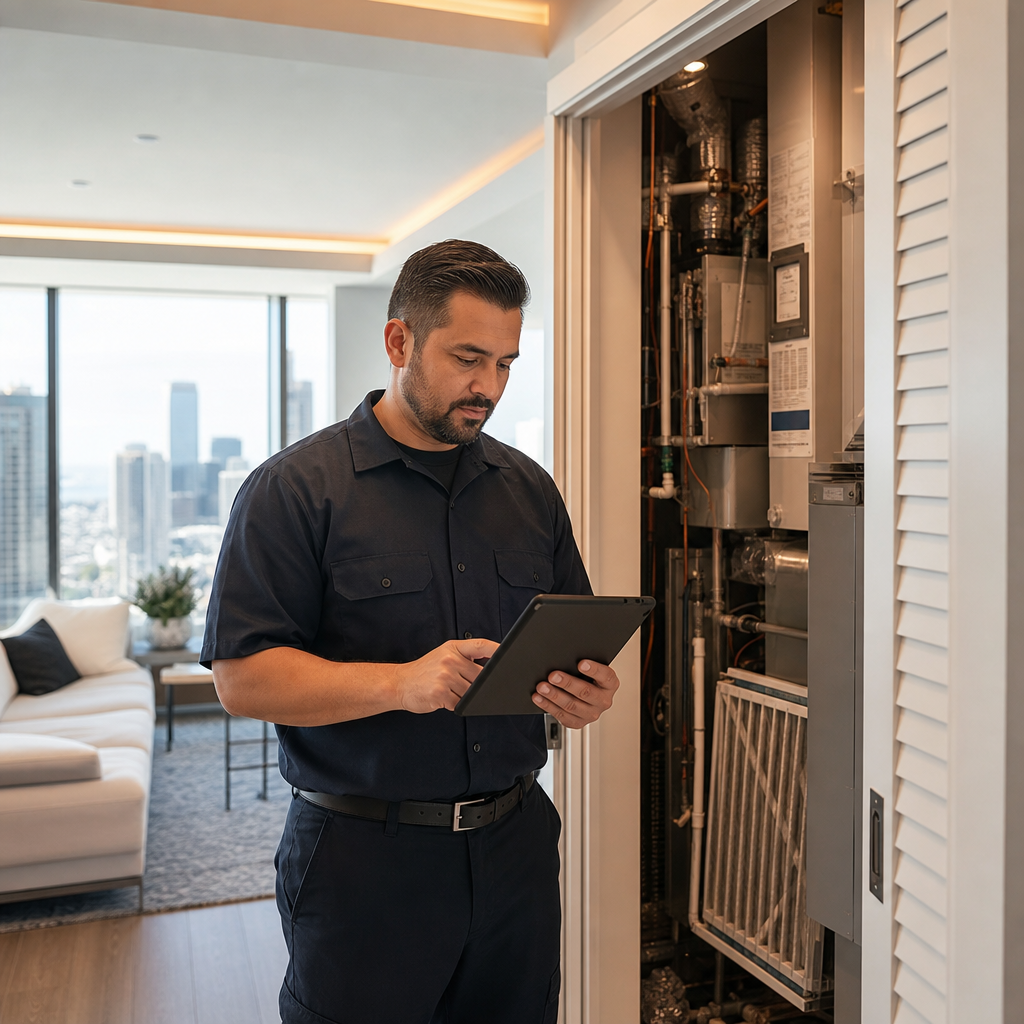
Many multi-family buildings and condominiums feature compact mechanical closets and internally lined ductwork designed to absorb sound. When aerosolized chemicals are sprayed into these systems without prior mechanical cleaning, porous fiberglass liners can trap chemical particulates. As air circulates, building occupants can experience chemical sensitivity, eye irritation, and persistent odors.
According to air monitoring data for Los Angeles County, the region recorded only 39 good air-quality days and 32 unhealthy or worse days during 2025. Outdoor particulate loads mean regional HVAC systems can accumulate significant dust. Proper indoor air sanitization requires removing that physical debris load from the system before any sanitizing agent is applied.[4]
Step-by-Step Mechanical Cleaning Sequence
To ensure thorough results and protect indoor air, technicians follow a systematic mechanical cleaning process:
- Evaporator Coils and Drain Pans: Technicians inspect and clean cooling coils and clear condensation pans, eliminating standing moisture that attracts mold growth.
- Blower Assembly and Housing: Dust buildup on blower wheels slows motor efficiency and restricts airflow. Technicians clean the housing and fan blades.
- Rotary Agitation and HEPA Capture: Flexible whips and rotary brushes dislodge adhered debris along supply and return runs while heavy-duty HEPA vacuums collect the particulates.
- Ductwork Seam Inspection: Technicians check accessible duct joints for gaps or disconnected runs that might pull dusty attic or wall-cavity air into the living space.
- Targeted Antimicrobial Application: With the system clean, an EPA-registered antimicrobial mist is applied to treat internal surfaces.
What Does HVAC Sanitization Cost?
No Century City specific neutral-source pricing was found; all figures below are Los Angeles area estimates only. Costs for residential air quality sanitizing across the greater Los Angeles area typically range from $250 to $600 for a standard single-system home. Larger multi-zone residences and commercial offices generally run between $500 and $1,200, depending on square footage, accessibility, and duct design.[3]
Pricing Overview
Below is an overview of estimated price ranges for professional duct cleaning and sanitizing packages in the Los Angeles area:[5]
| Service Scope | Standard Duct Cleaning | Mechanical + Sanitizing Package | Large Property / Commercial |
|---|---|---|---|
| Typical Cost Range | $250 – $600 | $320 – $750 | $500 – $1,200+ |
| Mechanical Agitation / HEPA Vacuuming | Included | Included | Included |
| EPA-Registered Antimicrobial Treatment | Optional add-on ($70 – $150) | Included | Included |
| Dryer Vent Cleaning | Add-on ($80 – $200) | Add-on ($80 – $200) | Custom Evaluation |
Factors That Influence Your Estimate
Final service costs depend on several property-specific variables:
- Accessibility of Mechanical Closets: Units with compact ceiling-mounted fan coils require specialized containment compared to ground-floor residential setups.
- Duct Material: Sheet metal ducts can handle aggressive mechanical brushing, while delicate flex ducts or internally insulated ducts require calibrated agitation tools.
- System Contamination Level: Ductwork with post-remodel drywall dust, heavy pet dander, or ash buildup requires extended run-time under negative air pressure.
Servicing Multi-Unit Condos, Penthouses, and High-Rise Systems
Need air quality sanitizing in Century City?
We’re available now — call for a fast, free estimate.
According to Pure Air Duct Cleaners, working in high-rise buildings and multi-unit residential communities requires containment procedures to avoid venting exhaust through hallways or disturbing neighboring units. Each system should be treated as a self-contained environment with localized negative air pressure.
- Zonal Isolation: Sealing return registers and supply grilles within the unit prevents dislodged dust from migrating into common areas or adjacent rooms during cleaning.
- Direct-to-HEPA Filtration: Commercial negative-air machines filter exhaust air through 99.97% efficient HEPA media to capture fine particulate matter.
- Exhaust and Dryer Line Clearing: Laundry dryer vents and bathroom exhaust runs are cleared to prevent lint blockages, reduce fire risks, and maintain exhaust airflow rates.
According to findings from a Lawrence Berkeley National Laboratory study, homes with functioning, code-compliant mechanical ventilation in the study sample showed 44% to 54% lower indoor PM2.5 concentrations compared to unventilated properties. Keeping mechanical ventilation components clean helps maintain intended system performance, though individual indoor air quality results depend on specific building conditions.[1]
Cleaning Protocols by HVAC System Type
| System Type | Typical Application | Primary Cleaning Focus |
|---|---|---|
| Variable-Speed Fan Coils | High-rises and modern condominiums | Cleaning multi-stage blowers, internal insulation, and clearing tight condensate drain pans. |
| Modular Air Handlers | Single-family homes and mid-century apartments | Scrubbing cabinet walls, cleaning coils, and clearing primary supply distribution plenums. |
| Ductless Mini-Splits & Heat Pumps | Architectural retrofits and renovated suites | Deep cleaning rotary blower wheels, evaporator fins, and treating internal drain troughs. |
| Compact Closet Units | Urban residential rentals and studios | Mechanical brush extraction under high negative pressure within restricted clearance areas. |
Frequently Asked Questions
How long does a professional air sanitizing service take?
A standard single-family home or residential condominium usually takes between 2.5 and 4 hours. Larger properties with multiple HVAC units or extensive duct networks can take 4 to 6 hours. Because mechanical cleaning requires setting up negative air containment on every run, Pure Air Duct Cleaners technicians take the necessary time to ensure thorough debris extraction.
Are sanitizing solutions safe for pets and children?
When applied according to label instructions by trained professionals, EPA-registered botanical and antimicrobial solutions are formulated for HVAC use. Ensuring ductwork is mechanically cleaned of dust prior to application allows the product to contact surfaces directly and dry properly without lingering chemical odors.
Can air quality sanitization eliminate mold and pet allergens?
Mechanical HEPA vacuuming physically removes accumulated pet dander, hair, and mold spores from duct surfaces. Following extraction, an antimicrobial mist can treat remaining microscopic organisms. For mold issues, any underlying moisture problems – such as a clogged condensate line or water leak – must also be corrected to prevent recurrence.
How often should indoor air sanitization and duct cleaning be performed?
According to EPA guidance, air duct cleaning is typically situational rather than necessary on a fixed calendar schedule. The EPA does not recommend routine cleaning at set intervals, but rather when specific conditions warrant service.
When does the EPA recommend air duct cleaning?
The U.S. Environmental Protection Agency (EPA) recommends duct cleaning under specific circumstances: when there is substantial visible mold growth inside the ducts or other HVAC components, when ducts are infested with vermin (such as rodents or insects), or when ducts are clogged with excessive amounts of dust and debris that release into living areas.
To address indoor air quality concerns, schedule an on-site duct inspection with a qualified HVAC cleaning professional from Pure Air Duct Cleaners.
Need air quality sanitizing in Century City?
We’re available now — call for a fast, free estimate.
Sources
- Indoor air quality in California homes with code-required mechanical … – pubmed.ncbi.nlm.nih.gov (2020)
- Legislature – Indoor Air Pollution in California – ww2.arb.ca.gov
- IV.B. Air Quality – Los Angeles City Planning – planning.lacity.gov
- Los Angeles County, California Annual AQI 74 (2025) – plainairdata.com (2025)
- Los Angeles-Long Beach-Anaheim, CA Air Quality: AQI 80, 10.1 … – plainairdata.com (2025)
Air Quality Sanitizing in Nearby Cities
We also serve the communities around Century City:
- Air Quality Sanitizing in Los Angeles
- Air Quality Sanitizing in Beverly Hills
- Air Quality Sanitizing in Burbank
- Air Quality Sanitizing in Culver City
- Air Quality Sanitizing in Echo Park
- Air Quality Sanitizing in Hollywood
- Air Quality Sanitizing in Koreatown
- Air Quality Sanitizing in North Hollywood
Frequently Asked Questions
How soon can I run my HVAC system after air quality sanitizing?
You can typically turn your HVAC system back on within 30 to 60 minutes after the antimicrobial application dries. Pure Air Duct Cleaners uses fast-acting, EPA-registered solutions applied to pre-cleaned duct surfaces, preventing chemical vapors or lingering residue from circulating into your living areas.
How does Pure Air Duct Cleaners meet HOA guidelines for high-rise condos in Century City?
Owner Larry Torres personally oversees multi-unit protocols, deploying localized negative-air containment to keep dislodged particulates from entering shared hallways or neighboring units. The Pure Air Duct Cleaners team utilizes hospital-grade, direct-to-HEPA filtration equipment designed to comply with strict high-rise building standards.
Why is air quality sanitizing necessary after a home remodel in Century City?
Remodeling projects create fine drywall dust, sawdust, and paint particulates that easily bypass standard air filters and coat internal duct walls. Pure Air Duct Cleaners performs deep mechanical HEPA extraction followed by antimicrobial sanitization to thoroughly clear construction debris before it recirculates into your home.
About the author
 |
Sarah Jenkins Sarah is a certified HVAC technician and indoor air quality specialist with over a decade of experience serving the Los Angeles area. She holds a B.S. in Environmental Science from UCLA and has dedicated her career to educating homeowners on the importance of duct maintenance and system efficiency. Her writing focuses on practical, cost-effective solutions for improving residential air quality and extending the life of HVAC systems. |
Dusty vents or weak airflow at home?
We’re available now — call for a fast, free estimate.
Call Now - Free Estimate