
Quick Summary
This guide explains the process of air duct sanitizing in Burbank, detailing why thorough mechanical cleaning must precede antimicrobial treatments to effectively manage mold, bacteria, and odors. Pure Air Duct Cleaners provides targeted, EPA-registered antimicrobial applications combined with mechanical agitation to eliminate contaminants at the source across residential HVAC systems. Readers will understand the key factors affecting service pricing and can contact Pure Air Duct Cleaners 24/7 to schedule a free on-site estimate.
Air Duct Sanitizing in Burbank – Clean Air & Odor Relief
Air duct sanitizing involves applying an antimicrobial product intended for HVAC use to the interior surfaces of a duct system to help manage microbial growth or odor-causing compounds, subject to product label directions and specific contamination conditions. While environmental dust and particulate matter can accumulate in ductwork over time, routine biocide use is not recommended by supplied EPA evidence. Sanitizing should generally be considered only after appropriate physical cleaning and when justified by specific conditions, such as confirmed microbial growth.[2]
For antimicrobial products to be applied properly, physical debris should first be removed through duct cleaning. Some industry sources suggest that applying sprays directly over settled dust may create a damp residue or impede treatment of duct surfaces, though this remains an unverified possibility. According to Pure Air Duct Cleaners, when treatment is warranted, thorough cleaning should precede any antimicrobial application.
Quick Answer: What Is Air Duct Sanitizing?
Quick answer: Air duct sanitizing is an antimicrobial treatment that may be applied after mechanical duct cleaning. While duct cleaning physically removes dirt, dust, and debris, sanitizing involves applying an HVAC-labeled antimicrobial product to help address residual bacteria, mold spores, or odors under specific conditions. Routine application of biocides is not recommended by the EPA, and sanitizing should generally only be considered when justified by conditions like confirmed microbial growth.
Sanitizing is an additional step beyond standard cleaning and may be evaluated when a home has experienced verified microbial contamination, pest intrusion, or moisture issues. It is not a substitute for physical cleaning or source removal.
Why Mechanical Cleaning Must Precede Duct Sanitizing
Applying an antimicrobial spray directly into uncleaned ductwork is generally discouraged. It is possible that chemical mists applied over accumulated particulate could result in a damp mixture on duct surfaces, potentially trapping odors or affecting airflow, though these outcomes are unverified possibilities rather than established facts. Regardless, as Pure Air Duct Cleaners points out, antimicrobial products are designed to be applied to clean surfaces according to their specific label directions.
Regional Particulate and Ventilation Considerations
Homes in the region may accumulate airborne dust, soot, and particulate over time depending on local conditions and building characteristics. General public health guidance, such as recommendations from Los Angeles County, notes that improving ventilation and using higher-efficiency filtration (such as MERV 13 filters) can help reduce indoor airborne contaminants. However, it should be noted that the Los Angeles County air-exchange study covered the broader metropolitan area and did not provide Burbank-specific findings. In addition, Pure Air Duct Cleaners notes that filtration only addresses circulating air, whereas settled material inside ductwork requires appropriate physical removal methods.[1]
Overview of a Possible Contractor Cleaning and Treatment Method
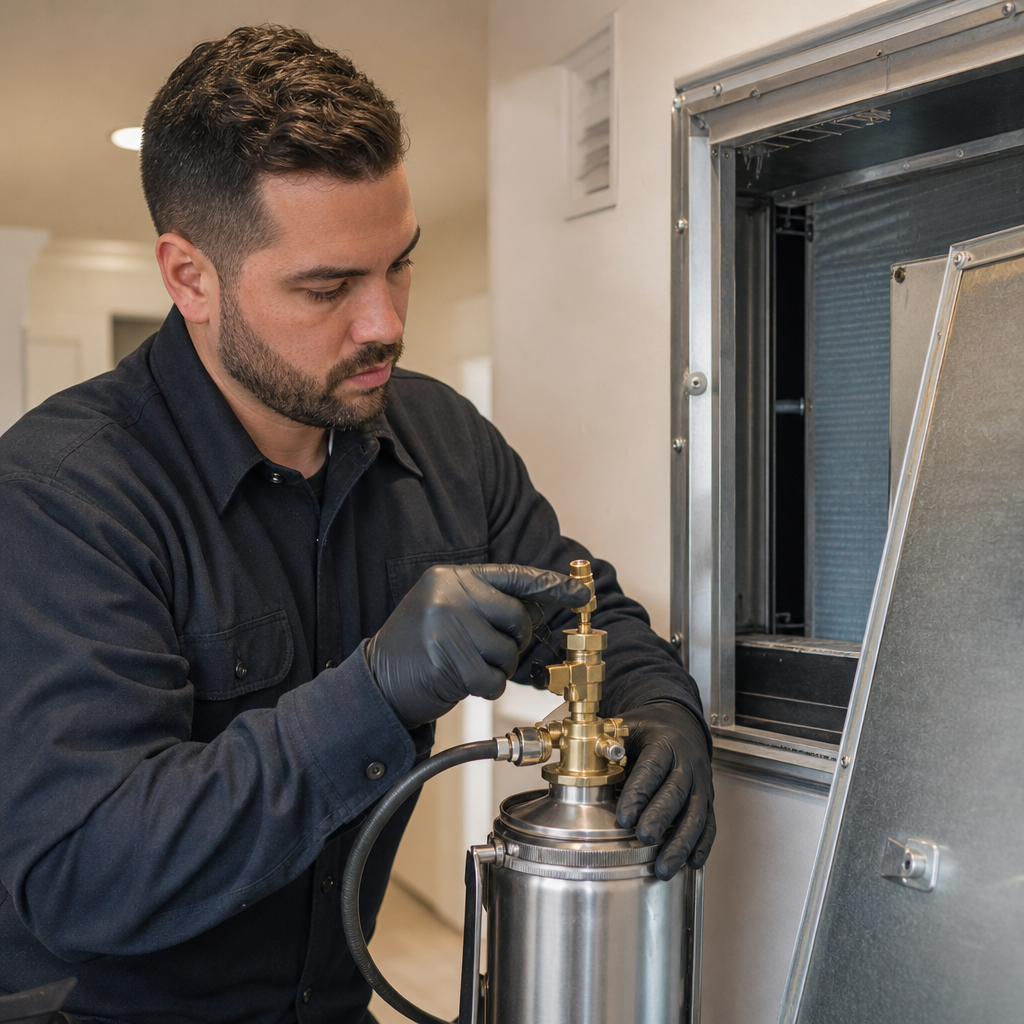
Contractors may employ various methods for duct cleaning and antimicrobial application depending on system design and contamination levels. One possible contractor method includes the following steps (though specific agitation tools, negative air systems, or HEPA extraction are not universally required for every system):
- Mechanical Agitation: Technicians may use agitation tools, such as brushes or air whips, to dislodge dust and debris from duct walls based on the duct material.
- Vacuum Extraction: Vacuum equipment, which may include negative pressure or HEPA-filtered collection units, captures dislodged debris to remove it from the system.
- Antimicrobial Application: If justified by conditions such as confirmed microbial growth, technicians may apply an EPA-registered antimicrobial product specifically labeled for HVAC use according to manufacturer instructions.
What Does Air Duct Sanitizing Cost in Burbank, CA?
Need air duct sanitizing in Burbank?
We’re available now — call for a fast, free estimate.
No reliable neutral Burbank-specific pricing was identified. Actual service costs vary based on factors such as system size, duct accessibility, degree of contamination, duct construction materials, and the specific antimicrobial product selected.[5]
Key Factors That Affect Your Estimate
- Duct Material: Flexible ducting, rigid sheet metal, and fiberglass duct board require different handling and application methods.
- System Accessibility: Difficult access in attics, crawlspaces, or multi-story layouts can increase labor requirements.
- Contamination Type and Severity: Addressing active microbial contamination, pest issues, or moisture damage requires specialized remediation protocols.
- System Size and Layout: Larger homes or multi-zone systems require additional time, equipment, and materials.
HVAC Component Considerations During Remediation
When addressing microbial contamination or moisture within an HVAC system, remediation must focus on the source of moisture and proper cleaning standards according to applicable guidelines and product labels.
Any antimicrobial treatment applied to components must strictly follow product label directions approved for those specific HVAC materials. As Pure Air Duct Cleaners emphasizes, treating components without resolving moisture sources or replacing damaged, porous materials will not provide lasting results.[4]
Frequently Asked Questions
What is the difference between air duct cleaning and air duct sanitizing?
Air duct cleaning is the physical removal of dust, dirt, and debris from HVAC ductwork. Air duct sanitizing is the application of an antimicrobial product labeled for HVAC use, intended to help control specific microbial contaminants or odors on clean surfaces when justified by conditions such as confirmed microbial growth. Routine biocide use is not recommended by supplied EPA evidence.
How much does air duct sanitizing cost in Burbank, CA?
No reliable neutral Burbank-specific price was identified. Cost estimates vary depending on property size, the number and accessibility of HVAC systems, the level of contamination, duct materials, and the specific products used.[3]
Are the sanitizing solutions used in air ducts safe for pets and children?
EPA registration alone does not establish safety for every HVAC application. The product must have specific directions for HVAC use, and occupants, children, and pets must follow the product label’s specific instructions regarding evacuation, ventilation, and re-entry times.
How often should residential HVAC ducts be sanitized?
Routine sanitizing of HVAC ducts is not recommended by the EPA. Sanitizing should generally be considered only when justified by specific conditions, such as confirmed microbial growth, water damage, or significant contamination, and only after thorough physical cleaning.
How long does an air duct sanitization service take?
Service times vary widely depending on the system size, layout, and extent of cleaning required. While some service providers offer estimates such as a few hours for cleaning and treatment, these are provider-specific estimates that are not verified by the research brief.
Can air duct sanitizing eliminate mold and foul odors?
According to Pure Air Duct Cleaners, air duct sanitizing is not guaranteed to eliminate mold or odors, and it is not a substitute for correcting moisture problems, water leaks, contamination sources, or damaged materials. Antimicrobial products can help reduce microbial growth or odor-causing organisms only when used according to label instructions in conjunction with source removal and moisture control.
Need air duct sanitizing in Burbank?
We’re available now — call for a fast, free estimate.
Sources
- [PDF] Exposure Factors Handbook – Chapter 19: Building Characteristics – epa.gov (2010)
- Proceedings of the Healthy Buildings 2009 Conference – osti.gov (2009)
- Despite Low COVID-19 Transmission in Los Angeles County, Data … – publichealth.lacounty.gov
- Research Agenda on Air Duct Cleaning – nepis.epa.gov
- Breathless in Los Angeles: The Exhausting Search for Clean Air – PMC – pmc.ncbi.nlm.nih.gov
Frequently Asked Questions
When is air duct sanitizing actually necessary instead of standard cleaning for Burbank homes?
Sanitizing is recommended when an HVAC system exhibits verified microbial growth, pest contamination, or lingering odor problems following moisture intrusion. Pure Air Duct Cleaners evaluates these specific conditions during an on-site inspection to determine if an EPA-registered antimicrobial application is warranted alongside deep physical cleaning.
Can flexible ductwork and fiberglass duct board be safely sanitized?
Yes, but flexible and fiberglass materials require gentle agitation and antimicrobial formulas strictly labeled for porous HVAC surfaces. Pure Air Duct Cleaners customizes treatment methods to your duct material, ensuring proper sanitization without degrading delicate internal linings.
How soon can residents and pets re-enter the home after air duct sanitizing?
Occupants can typically return within 1 to 4 hours, depending on the specific antimicrobial product applied and the ventilation rate of the home. Pure Air Duct Cleaners follows strict label guidelines and provides exact re-entry timelines to ensure safety during air duct sanitizing in Burbank.
About the author
 |
Sarah Jenkins Sarah is a certified HVAC technician and indoor air quality specialist with over a decade of experience serving the Los Angeles area. She holds a B.S. in Environmental Science from UCLA and has dedicated her career to educating homeowners on the importance of duct maintenance and system efficiency. Her writing focuses on practical, cost-effective solutions for improving residential air quality and extending the life of HVAC systems. |
Dusty vents or weak airflow at home?
We’re available now — call for a fast, free estimate.
Call Now - Free Estimate