
Quick Summary
This guide examines proper protocols for air quality sanitizing in Burbank, outlining why mechanical debris extraction is vital before applying chemical biocides to residential HVAC systems. Pure Air Duct Cleaners provides EPA-aligned decontamination by combining high-efficiency mechanical HEPA negative-air extraction with targeted, EPA-registered antimicrobial treatments for verified biological growth. Readers will learn regional service cost ranges and how to contact Pure Air Duct Cleaners to request a free, no-obligation air quality sanitizing estimate in Burbank.
Air Quality Sanitizing in Burbank – Clean Air and HVAC Care
Indoor air systems in Burbank and surrounding communities can accumulate dust and outdoor airborne particles over time. When these particulates enter heating and cooling systems, they can settle inside ductwork and mechanical equipment.[2]
According to guidance from environmental health agencies such as the EPA and specialists like Pure Air Duct Cleaners, proper HVAC care requires mechanical cleaning to remove physical debris first. Routine chemical fogging or sanitizing is not recommended as a standard service. Here is what homeowners should know about HVAC cleaning, source removal, and indoor air management.
How professional HVAC cleaning and sanitizing works
Professional HVAC cleaning focuses primarily on mechanical source removal: technicians use HEPA-filtered negative air vacuums and mechanical agitation tools to dislodge and extract dust and debris from duct surfaces. If verified biological growth such as mold is present on non-porous components, an EPA-registered antimicrobial treatment labeled specifically for HVAC systems may be applied directly to clean, dry surfaces.[1]
The EPA does not recommend relying on chemical sanitizers or fogs as a routine substitute for physical cleaning. Effective HVAC maintenance relies on mechanical source removal, moisture control, and proper filtration to maintain indoor air quality without introducing unnecessary airborne irritants.[4]
Mechanical HEPA extraction and targeted sanitizing
As recommended by Pure Air Duct Cleaners, a dependable duct cleaning procedure follows these steps:
- Agitation: Rotating brushes, polymer whips, or compressed air sweeps loosen dust and debris from the interior walls of supply and return ducts.
- Negative Air Extraction: A HEPA-filtered collection unit places the duct system under negative pressure, capturing dislodged debris directly into sealed filters.
- Targeted Antimicrobial Application: If inspection confirms microbial growth on non-porous components, an EPA-registered biocide approved for HVAC use may be applied strictly according to manufacturer label directions after surfaces are thoroughly cleaned and dry.
Environmental factors and the limits of chemical treatments
Duct systems naturally collect dust and ambient airborne particles over time. When addressing indoor air concerns, relying on aerosol chemical sprays or fogging is not recommended by the EPA.
Spraying wet sanitizers or biocides into dirty ductwork does not eliminate accumulated physical debris and may introduce moisture or chemical irritants into the air system. Physical source removal and moisture control must always be prioritized over chemical applications.
Why physical cleaning must precede sanitizing
The EPA advises against applying biocides or chemical sanitizers to uncleaned duct surfaces. Chemical treatments cannot penetrate heavy layers of dust to treat underlying contamination, and introducing unnecessary liquids into ductwork can create moisture conditions that support microbial growth.
Particulate buildup inside residential systems
Over time, residential duct systems accumulate ambient dust and particulates through regular operation. If left unaddressed, heavy accumulation can restrict airflow, coat blower fan assemblies, and reduce overall system efficiency.
EPA standards for duct biocides
The EPA emphasizes that chemical sanitizers, sealants, and biocides should not be applied as a routine, automatic service. Their use is limited to situations where biological contamination is verified, and only after all dust and debris have been mechanically removed from dry components.
| Feature | Aerosol Fogging Alone | Basic Surface Dusting | Mechanical Source Extraction with Targeted Sanitizing |
|---|---|---|---|
| Debris Removal | Leaves physical dust and particulate behind | Cleans only accessible vent covers | Pulls debris out under HEPA negative pressure |
| Moisture and Chemical Risk | Risk of introducing unneeded moisture and chemical irritants | Keeps duct interior dry | Surfaces are mechanically cleaned and kept dry |
| Antimicrobial Use | Sprayed indiscriminately without source removal | None used | Applied selectively to confirmed microbial areas only |
| EPA Alignment | Not recommended by the EPA | Incomplete source removal | Follows EPA source-removal guidelines |
HVAC components that require inspection and cleaning
Need air quality sanitizing in Burbank?
We’re available now — call for a fast, free estimate.
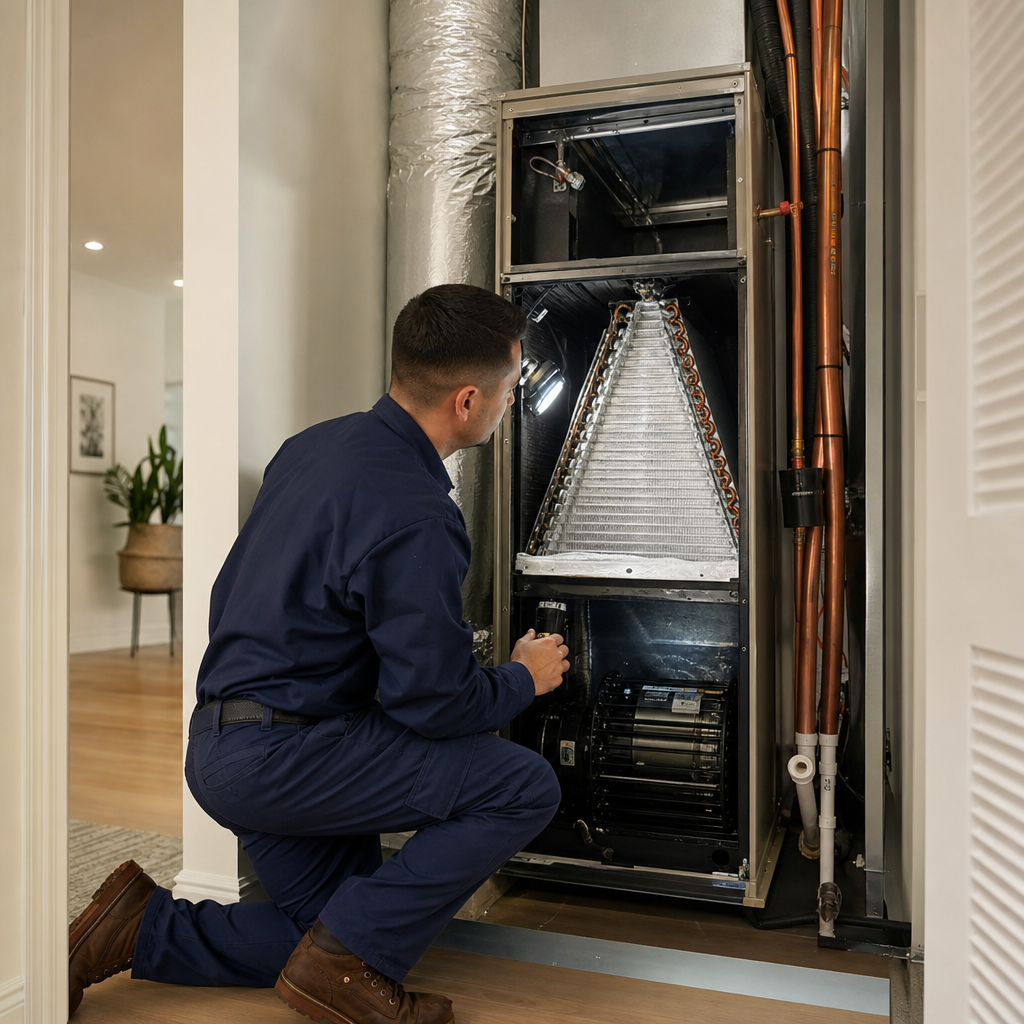
A complete HVAC evaluation covers the entire air stream rather than just visible register covers.
Evaporator coils and blower assemblies
As warm indoor air passes over the cold evaporator coil, moisture condenses and drains away. If particulate bypasses the air filter, it can accumulate on damp coil surfaces and drain pans, potentially supporting microbial growth. Technicians inspect the coil, clean the condensate pan, clear the drain line, and clean blower wheel blades to maintain balanced airflow.
Supply, return, and flexible ductwork
Homes may feature rigid sheet metal trunk lines, flexible spiral ducting, or a combination of both. Sheet metal handles mechanical brush agitation well, but as Pure Air Duct Cleaners notes, flexible ducts have a thin inner core that requires careful handling and calibrated equipment to avoid tears and air leaks.
Dryer vents and exhaust runs
Exhaust systems, including laundry dryer vents, run alongside heating and cooling layouts. When lint accumulates in a dryer vent line, drying efficiency decreases and fire risks rise. Clearing lint through to the exterior exhaust cap ensures proper airflow and venting.
Estimated costs for duct cleaning and sanitizing
Pricing for duct cleaning depends on home square footage, the number of air handlers, accessibility, and the condition of the ductwork. Homeowners should obtain upfront, itemized quotes detailing the mechanical cleaning methods used, an approach advocated by Pure Air Duct Cleaners.
Los Angeles area price ranges
The following figures reflect general price ranges across the broader Los Angeles area, though local quotes in Burbank may vary:[3]
- Standard single-system duct cleaning: $300 – $650 (covers standard supply and return ducts under HEPA negative air containment).
- Targeted antimicrobial application: $75 – $150 (applied only when verified microbial growth is present on specific mechanical components).
- Dryer vent cleaning: $90 – $200 (varies based on run length and termination point).
- Multi-system or larger residential homes: $600 – $1,300+ (for dual-zone systems or extensive duct networks).
Key factors that affect your estimate
Cost varies based on whether ductwork is accessible in an attic or crawlspace, the level of debris present, and whether specialized component cleaning is required. Routine filter replacement, proper ventilation, and moisture management are the most effective ways to maintain system performance.
Frequently asked questions
How much does HVAC duct cleaning cost?
Across the broader Los Angeles area, standard mechanical duct cleaning generally ranges between $300 and $650 for a single system, with larger or multi-unit homes costing more. Because local quotes in Burbank will vary, homeowners should request an on-site written estimate detailing the specific cleaning process.[5]
What methods are used to clean and sanitize ductwork?
The primary method is mechanical source removal using HEPA-filtered negative air vacuums and physical agitation tools. Chemical sanitizers and biocides are not recommended for routine use and should only be applied in verified cases of microbial contamination on cleaned, non-porous surfaces.
How often should homeowners have their air systems cleaned?
The EPA does not recommend duct cleaning on a fixed calendar schedule. Instead, service should be condition-based, such as when there is substantial visible mold growth, a vermin infestation, or when ducts are clogged with excessive amounts of dust and debris.
Is chemical duct sanitization safe for indoor spaces?
The EPA does not recommend routine chemical sanitization due to potential chemical exposure risks and unverified benefits. Safer and more effective approaches for maintaining healthy indoor air include mechanical source removal, proper ventilation, moisture control, and regular air filtration.
What are the main signs that air ducts need cleaning?
According to EPA guidance, the primary reasons to clean ductwork include visible mold growth inside hard-surface ducts or on mechanical components, duct systems infested with rodents or insects, or ducts that are severely clogged with dust and debris that releases into living areas.
How does air duct sanitization differ from standard air duct cleaning?
As explained by Pure Air Duct Cleaners, standard air duct cleaning focuses on the physical extraction of dust, dirt, and debris using mechanical tools and vacuums. Sanitization is a secondary step involving the cautious application of an EPA-registered biocide, which is only recommended in specific, verified instances of biological contamination on thoroughly cleaned surfaces.
Need air quality sanitizing in Burbank?
We’re available now — call for a fast, free estimate.
Sources
- Air Quality – Cities and Counties | US EPA – epa.gov (2025)
- PM2.5 air pollution, mean annual exposure (micrograms … – data.worldbank.org (2026)
- Burbank, California, United States Historical Air Quality Analysis – aqi.in (2026)
- Burbank Air Quality Index (AQI) : Real-Time Air Pollution – aqi.in (2025)
- North Hollywood Air Quality Index (AQI) : Real-Time Air Pollution – aqi.in (2025)
Air Quality Sanitizing in Nearby Cities
We also serve the communities around Burbank:
- Air Quality Sanitizing in Los Angeles
- Air Quality Sanitizing in Beverly Hills
- Air Quality Sanitizing in Century City
- Air Quality Sanitizing in Culver City
- Air Quality Sanitizing in Echo Park
- Air Quality Sanitizing in Hollywood
- Air Quality Sanitizing in Koreatown
- Air Quality Sanitizing in North Hollywood
Frequently Asked Questions
How does Pure Air Duct Cleaners safely sanitize flexible ductwork in Burbank homes?
Because flexible ducts feature a delicate inner core susceptible to punctures, Pure Air Duct Cleaners uses specialized, calibrated agitation tools paired with HEPA negative-air extraction. This ensures complete debris removal and safe antimicrobial application without compromising the structural integrity of your duct lines.
What is included in a free air quality sanitizing estimate in Burbank?
A comprehensive estimate from Pure Air Duct Cleaners covers a full evaluation of supply and return runs, blower fans, and evaporator coil conditions. Homeowners receive an upfront, itemized quote detailing the mechanical HEPA extraction process and any targeted, EPA-registered treatments required for biological growth.
Do occupants need to leave the home during an air quality sanitizing treatment?
Most residents can remain at home because Pure Air Duct Cleaners prioritizes contained mechanical HEPA extraction over indiscriminate aerosol fogging. When targeted, EPA-registered antimicrobials are applied to specific non-porous components, technicians ensure the area is properly contained and ventilated until dry.
About the author
 |
Sarah Jenkins Sarah is a certified HVAC technician and indoor air quality specialist with over a decade of experience serving the Los Angeles area. She holds a B.S. in Environmental Science from UCLA and has dedicated her career to educating homeowners on the importance of duct maintenance and system efficiency. Her writing focuses on practical, cost-effective solutions for improving residential air quality and extending the life of HVAC systems. |
Dusty vents or weak airflow at home?
We’re available now — call for a fast, free estimate.
Call Now - Free Estimate