
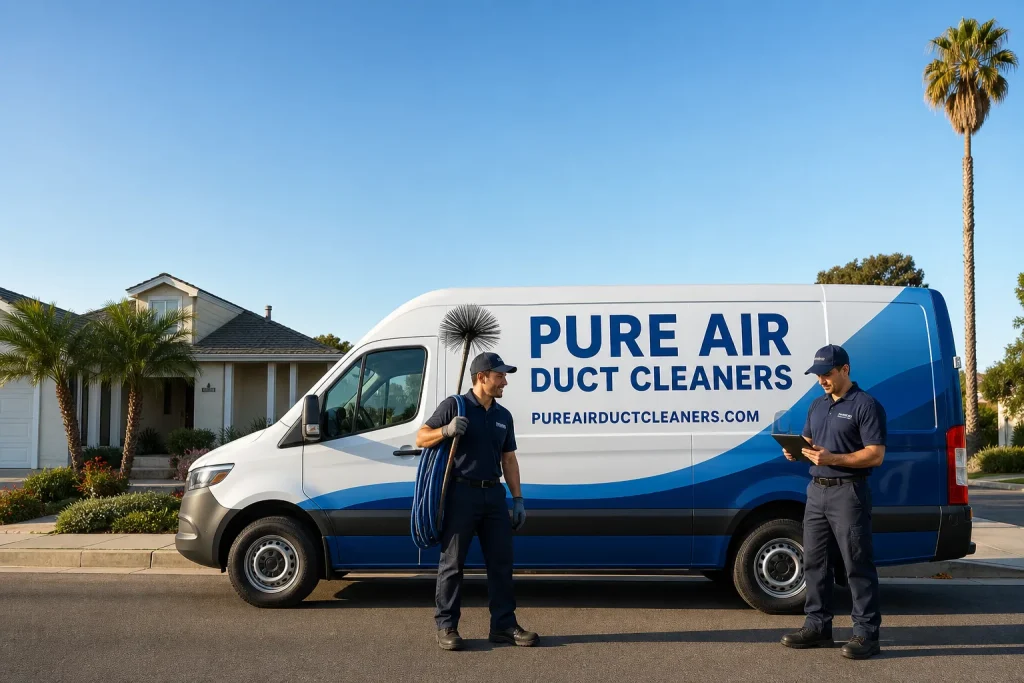
Last updated July 12, 2026
The Complete Guide to Air Duct Cleaning in Los Angeles
After the 2023 wildfire smoke season, air quality researchers found ultrafine particulate matter embedded in flexible duct liner material up to 18 inches from register openings — the kind of microscopic contamination a single shop-vac pass wouldn’t come close to touching. That finding matters specifically in Los Angeles, where ducts face a combination of wildfire smoke, marine layer humidity, drought-season dust, and aging construction that makes generic national advice about duct cleaning nearly useless. This guide covers what’s actually inside LA ducts, how professional cleaning works step by step, what the local market looks like when it comes to pricing and protocols, and what to look for — and avoid — when hiring a contractor in this city.
Quick Answer
Air Duct Cleaning in Los Angeles typically costs between $300 and $600 for a standard single-family home and should be performed every 3 to 5 years — more frequently after wildfire smoke events, major renovations, or if anyone in the home has respiratory sensitivities. Los Angeles ducts face unique contamination drivers including wildfire-deposited fine particulate, marine layer moisture that promotes mold growth inside ductwork, and drought-season dust infiltration, which means the cleaning process and the equipment used genuinely matter more here than in most U.S. markets.
Table of Contents
- Why Los Angeles Ducts Are Different From the Rest of the Country
- The Marine Layer Problem: How Coastal Humidity Gets Inside Your Ducts
- Wildfire Smoke Infiltration: Why It Requires a Different Cleaning Protocol
- Older Construction and Duct Types: Flex Duct vs. Sheet Metal in LA Homes
- What a Rotobrush System Actually Does vs. a Vacuum-Only Service
- How to Read an Honest Post-Cleaning Report
- Air Duct Cleaning Costs in Los Angeles: What’s Fair, What’s a Red Flag
- Common Mistakes to Avoid
- When to Call a Professional
- Frequently Asked Questions
- The Bottom Line
Why Los Angeles Ducts Are Different From the Rest of the Country
Most duct cleaning guides are written for the national average — moderate humidity, seasonal temperature swings, relatively clean outdoor air punctuated by pollen seasons. Los Angeles doesn’t fit that template at all. The air quality challenges here are layered in ways that compound inside a closed duct system, and if your contractor doesn’t understand that layering, the cleaning they perform won’t fully address what’s actually in there.
Here’s what Los Angeles ducts are actually contending with year-round:
- Wildfire fine particulate (PM2.5 and smaller): During smoke events, ultrafine particles bypass standard filtration and embed into flexible duct liner. This isn’t surface dust — it bonds to the material and requires mechanical agitation to release, not just suction.
- Marine layer moisture cycling: In coastal neighborhoods from Venice to Pacific Palisades, overnight humidity regularly reaches the 80–90% range. When that damp air cycles through an HVAC system, it creates condensation conditions inside ducts that accelerate mold and mildew growth.
- Drought-season dust loading: During extended dry periods, fine mineral dust from exposed soil and construction sites loads into return-air systems at a rate that can visibly coat duct interiors within a single season.
- Urban particulate from traffic corridors: Homes near the 405, 10, or 101 corridors show consistently higher interior dust loading than comparable homes in quieter ZIP codes — something we see consistently in the field.
- Post-construction debris: Los Angeles has been in a near-continuous renovation cycle across neighborhoods like Silver Lake, Highland Park, and Glassell Park. Drywall dust from adjacent work — even a neighbor’s remodel — can infiltrate a connected HVAC return.
Understanding which of these factors is dominant in your home changes both how the cleaning should be done and what products are appropriate after the cleaning is complete. A one-size-fits-all blowout isn’t a solution when the contaminants themselves aren’t uniform.
The Marine Layer Problem: How Coastal Humidity Gets Inside Your Ducts
The marine layer is one of Los Angeles’s defining weather features — and one of the least-discussed factors in local duct contamination. Every night from roughly May through September, moisture-heavy air rolls in from the Pacific and settles over coastal and basin communities. When an HVAC system pulls that humid return air through ducts that aren’t well-insulated or that have minor duct leaks, the temperature differential between the cool duct wall and the humid air creates condensation.
That condensation doesn’t have to be dramatic to cause a problem. A thin film of moisture cycling daily is enough to support mold and mildew growth inside flexible duct liner — particularly in homes built before 1990, where duct insulation values and sealing standards were considerably lower than today. In our experience working across Los Angeles, marine-layer-related mold growth is most common in:
- Crawlspace duct runs on pier-and-beam homes in areas like Los Feliz and Eagle Rock
- Attic duct systems in homes without proper attic ventilation (a common issue in older West LA bungalows)
- Flex duct runs longer than 15 feet where sag creates standing moisture points
- Any system with supply/return imbalance that causes negative pressure and draws unconditioned attic or crawlspace air
The distinction between inland and coastal Los Angeles matters here. A home in Encino — significantly more arid — has a very different humidity profile inside its ducts compared to a home in Santa Monica, even if both are in the Los Angeles metro area. A cleaning protocol built for Encino dust loads may miss the mold remediation step that a Santa Monica home genuinely needs.
When moisture-driven contamination is suspected, professional sanitizing with an EPA-registered product like those from Abatement Technologies is the appropriate follow-up after mechanical cleaning — not an optional add-on.
Wildfire Smoke Infiltration: Why It Requires a Different Cleaning Protocol
Standard duct cleaning is designed to address settled dust, debris, and biological growth that accumulates over years of normal HVAC operation. Wildfire smoke infiltration is a categorically different problem, and conflating the two is one of the most common errors we see contractors make — and homeowners accept without knowing better.
During a significant smoke event — and Los Angeles has had several severe ones since 2017 — the HVAC system becomes one of the primary pathways for fine smoke particles to enter the home. Even with the system set to “off,” return grilles are not airtight, and pressure differentials draw outside air through the duct network. PM2.5 particles (2.5 microns and smaller) are small enough to embed into the fibrous inner surface of flex duct insulation rather than simply sitting on top of it.
Here’s what a proper post-wildfire duct cleaning protocol should include — and what to ask your contractor before they start work:
- Inspection of register areas for smoke residue: Visible darkening or an oily residue near register openings is a sign that PM2.5 has moved deep into the duct run. Ask to see photos before cleaning begins.
- Mechanical agitation — not just suction: A vacuum-only service will not dislodge embedded fine particulate. Rotary brush systems like the Rotobrush are designed to physically scrub liner surfaces and release embedded material for extraction. This step is non-negotiable after a smoke event.
- HEPA-rated extraction: The Nikro system uses HEPA-filtration vacuuming rated to capture particles down to 0.3 microns. Anything less than HEPA-rated extraction during a smoke cleanup risks redistributing fine particles back into the home air.
- Filter replacement: Any MERV-rated filter in the system after a smoke event should be replaced before the system is run again — even if it was recently installed. Loaded filters push the system to work harder and can back-release captured particles.
- Post-cleaning sanitizing: Smoke odor and volatile organic compounds can persist even after particulate removal. An antimicrobial treatment using Abatement Technologies or Guardsman products addresses residual odor and surface contamination.
- Air quality verification: Before and after particulate readings using a handheld PM monitor are the honest way to confirm the cleaning worked. A contractor who resists this step is worth questioning.
If you call a contractor and they don’t differentiate between smoke cleaning and routine cleaning when you describe the situation, that’s important information about their level of expertise.
Older Construction and Duct Types: Flex Duct vs. Sheet Metal in LA Homes
Los Angeles has an unusually wide range of construction eras represented in its residential housing stock — everything from 1920s Craftsman bungalows in Pasadena to 1970s stucco tract homes in Northridge to 2010s new construction in Playa Vista. The duct type in a home is almost entirely determined by when it was built and when the HVAC system was last replaced, and it changes everything about how cleaning should be performed.
Sheet metal ductwork is found predominantly in commercial buildings and in residential homes where the HVAC was replaced or newly installed after roughly 2005 with a higher-grade system. Sheet metal is smooth-walled, rigid, and relatively durable. It’s also easier to clean mechanically because the rotary brush has a consistent surface to work against. The main challenge with sheet metal in older Los Angeles homes is that seams and joints were often sealed with duct tape — which dries out and fails in attic temperatures that regularly exceed 140°F during summer. Failed seam sealing means conditioned air is leaking into the attic and contaminated attic air is getting pulled into the supply side.
Flexible duct (flex duct) is the dominant duct material in residential Los Angeles homes built or retrofitted from the 1970s through the 1990s. It consists of a wire coil wrapped in an inner plastic liner, then a layer of fiberglass insulation, then an outer vapor barrier jacket. The inner plastic liner is the critical surface — it’s where contamination accumulates, and it’s inherently more textured and fragile than sheet metal.
Cleaning flex duct requires a lighter touch on the rotary brush and more attention to existing damage. In homes across the San Fernando Valley and older parts of East Los Angeles, we regularly find flex duct that has partially collapsed from age, animal damage, or improper installation — sometimes with sections that have completely disconnected from their collars. Cleaning a disconnected duct section just distributes the debris into the attic or crawlspace rather than extracting it.
This is why a pre-cleaning visual inspection — ideally with a duct camera — is part of a professional job, not an upsell. It changes the cleaning approach, and occasionally reveals that sections need to be repaired or replaced before cleaning can be effective. For more on what professional service looks like in a mixed-construction area, our Air Duct Cleaning in West Hollywood page covers that neighborhood’s specific duct profile in detail.
What a Rotobrush System Actually Does vs. a Vacuum-Only Service
The most important equipment question to ask any duct cleaning contractor in Los Angeles is simple: “Do you use rotary brush agitation, or is it vacuum-only?” The answer tells you almost everything about what the cleaning will actually accomplish.
Here’s an honest step-by-step breakdown of what a Rotobrush system does during a professional cleaning:
- System inspection and access setup: The technician inspects the system visually, identifies the number of supply and return registers, and confirms duct type and condition. Access is created at the main trunk line for the vacuum collection hose from the Nikro unit.
- HEPA vacuum attachment: The Nikro HEPA vacuum is connected to the main collection point and set to negative pressure. This is running throughout the brush agitation phase — it creates the suction that removes dislodged material before it can re-enter the home.
- Rotary brush cleaning, register by register: The Rotobrush — a flexible, rotating brush system driven through the duct run — mechanically scrubs the duct walls as it moves. For a typical Los Angeles home, this is done at every supply register. The brush physically dislodges settled dust, embedded particulate, biological growth, and construction debris that suction alone won’t release.
- Trunk line cleaning: The main supply and return trunk lines are cleaned separately with a larger brush head. This is where the heaviest debris accumulation typically lives — and it’s a section vacuum-only services frequently skip.
- Final vacuum pass and register cleaning: Each register is wiped and vacuumed individually. The grilles are removed, cleaned, and reinstalled.
- Sanitizing application (if applicable): If microbial treatment is warranted — post-wildfire, post-mold event, or for allergy-sensitive households — an EPA-registered product is fogged or applied through the system at this stage using Abatement Technologies or Guardsman products.
- Post-cleaning documentation: Photos at the trunk line and representative duct sections, before and after, should be provided. We cover what to look for in those photos in the next section.
A vacuum-only service — typically offered by low-bid crews advertising $49 or $99 whole-house specials — skips steps 3, 4, and often 6. It may reduce surface dust briefly, but it does nothing for embedded wildfire particulate, compacted debris in trunk lines, or biological growth on duct liner. In a market like Los Angeles where all three of those issues are common, vacuum-only is not a useful service. It’s a transaction that creates the appearance of cleaning without delivering it.
Professional-grade Rotobrush and Nikro equipment — not hardware-store shop vacs — is what separates a measurable result from a truck that came and went.
How to Read an Honest Post-Cleaning Report
A legitimate duct cleaning job should leave you with documentation that proves the work was done. In an industry with a well-documented history of cut-rate operators, the post-cleaning report is your protection — and knowing how to read it keeps contractors honest.
Here’s what an honest report should include:
- Before and after photos of the main trunk line: This is the most important single indicator. The trunk line accumulates the heaviest debris, and the before/after comparison should show visible change. If a contractor shows you only register-level photos, ask specifically for trunk line documentation.
- Photos of at least 2-3 individual duct runs: Not just the first register near the air handler — a representative sample from different zones of the home. Long duct runs behave differently than short ones.
- Documentation of any damage found: Disconnected flex duct sections, collapsed liner, failed duct tape seams, signs of pest activity (common in Los Angeles attic systems — roof rats, in particular, cause significant duct damage in neighborhoods like Silver Lake and Mt. Washington). A contractor who doesn’t mention any findings in a 20-year-old flex duct system either didn’t look or isn’t telling you.
- Filter condition note: The pre- and post-cleaning filter condition should be mentioned. This is both a service checkpoint and documentation that the system won’t be run with a debris-loaded filter after the cleaning.
- Sanitizing product identification: If a sanitizing treatment was applied, the report should name the product used (for example, an Abatement Technologies EPA-registered antimicrobial), the application method, and the treated areas. This matters for allergy sufferers and for any household with immunocompromised members.
- Air quality readings, if taken: Before and after PM readings at supply registers using a handheld particle counter are the gold standard for verifiable results. Not every job requires this, but post-wildfire cleanings absolutely should include it.
If a contractor hands you a single-page invoice with no photos and no findings — that’s not a post-cleaning report. That’s a receipt. The two are not the same thing.
Air Duct Cleaning Costs in Los Angeles: What’s Fair, What’s a Red Flag
Los Angeles has one of the most price-fragmented duct cleaning markets in the country, ranging from $49 bait-and-switch specials to $1,500+ whole-system jobs at certain premium providers. Here’s a realistic breakdown of what honest pricing looks like in this market as of 2025–2026:
- Standard residential cleaning (under 2,000 sq ft, 8–12 registers): $300–$450. This covers a full rotary brush and HEPA vacuum cleaning of all supply and return registers plus the main trunk lines.
- Larger homes (2,000–3,500 sq ft, 13–20+ registers): $450–$650. Register count and duct run length drive the labor time, which drives the price.
- Post-wildfire or post-construction cleaning: Add $100–$200 to standard rates, reflecting additional cleaning passes, HEPA filter usage, and post-cleaning sanitizing.
- Sanitizing treatment add-on: $75–$150 depending on system size and product used. Products like those from Abatement Technologies and Guardsman are commercial-grade — this is not a can of Lysine and a garden sprayer.
- Dryer vent cleaning: $85–$150 as a standalone service, often discounted when combined with a duct cleaning appointment. Our Dryer Vent Cleaning in West Hollywood page has more detail on that service specifically.
- HVAC coil and air handler cleaning: $150–$300 depending on accessibility and system type. Cleaning just the ducts while leaving a debris-coated evaporator coil is a common oversight — the coil re-contaminates clean ducts within weeks. See our HVAC Cleaning in West Hollywood page for what that service involves.
Red flags on pricing: Any whole-house quote under $150 in the Los Angeles market is either a bait-and-switch (the real price appears during the job), a vacuum-only service with consumer-grade equipment, or both. A legitimate professional cleaning with commercial rotary brush equipment cannot be profitably delivered at that price point — the labor time alone rules it out.
Common Mistakes to Avoid
- Hiring based on price alone: The $69 special that shows up on Groupon or in a door-hanger flier is almost universally a bait-and-switch. By the time the crew has inventoried your registers and pointed out “problem areas,” the price has tripled — and the equipment they brought still won’t do what a Rotobrush system does. For a thorough walkthrough of vetting contractors, see our How to Hire a Air Duct Cleaning Contractor in Los Angeles: A Step-by-Step Guide.
- Cleaning ducts without inspecting them first: In Los Angeles homes older than 30 years, unchecked flex duct may be partially collapsed or disconnected. Cleaning a disconnected duct section just blows debris into the attic. Always confirm that a pre-cleaning inspection is part of the service.
- Skipping HVAC cleaning when cleaning ducts: Clean ducts connected to a dirty evaporator coil or air handler will be recontaminated within weeks. The two services should be evaluated together — they share a system.
- Assuming one cleaning is permanent: In Los Angeles, wildfire seasons and high-dust environments mean most homes benefit from cleaning every 3–5 years, not once per decade. Homes with pets, allergy sufferers, or recent renovations are on the shorter end of that range.
- Ignoring post-wildfire smoke events: Many homeowners in Los Angeles treat visible smoke exposure as an outdoor problem that stays outside. Ultrafine particles that have embedded in duct liner will continue re-circulating through the HVAC system every time the fan runs until mechanically removed.
- Not asking about the contractor’s equipment: Ask specifically whether they use a rotary brush system or vacuum-only. If they can’t name their equipment, or describe their system as a “high-powered truck mount” without specifying brush agitation, you’re likely looking at a vacuum-only service.
- Skipping sanitizing after mold or smoke events: Mechanical cleaning removes particulate material — it doesn’t neutralize mold spores or smoke VOCs that have absorbed into duct liner. Sanitizing with an EPA-registered product is the necessary second step when biological or smoke contamination is present.
When to Call a Professional
Some situations call for immediate professional evaluation rather than a scheduled cleaning:
- Your home was in or near a significant wildfire smoke event in the last 12 months and the HVAC system was running during any part of it
- You’re noticing a persistent musty or smoke smell when the HVAC system runs — particularly common in coastal Los Angeles neighborhoods after marine-layer-heavy winters
- You’ve completed a renovation that generated drywall, plaster, or demolition dust, and the HVAC system was not fully sealed during the work
- An allergy or asthma sufferer in the home has experienced worsening symptoms without an obvious cause
- You can see visible dust or debris at supply registers, or dark staining around return grilles
- You’ve moved into a home and have no documentation of when the ducts were last cleaned
Pure Air Duct Cleaners offers free estimates in Los Angeles — Larry Torres will give you a straight answer about what the system actually needs rather than a sales pitch. Call (844) 734-2955 to schedule yours.
Frequently Asked Questions
How often should air ducts be cleaned in Los Angeles?
Most Los Angeles homes should have their ducts cleaned every 3 to 5 years — but that standard shortens significantly after wildfire smoke exposure, major renovations, or if pets or allergy sufferers are present in the home. The LA climate, with its combination of dry-season dust loading and marine-layer humidity cycling, accelerates contamination faster than the national average that most national guides reference.
Does air duct cleaning actually improve indoor air quality?
Yes — when done with mechanical agitation (rotary brush) and HEPA-rated extraction, professional duct cleaning measurably reduces the airborne particle load that recirculates each time your HVAC system runs. Vacuum-only services show weaker results because they don’t dislodge embedded particulate. Before and after PM readings at supply registers are the most reliable way to verify the improvement.
How do I know if my Los Angeles home needs duct cleaning after a wildfire?
If your HVAC system was operating during a nearby wildfire event — or even if it was off but return-air grilles were exposed to heavy smoke — the duct liner has likely captured PM2.5 particulate that standard operation won’t clear. Visible discoloration around registers, persistent smoke odor when the system runs, or air quality readings elevated above baseline indoor PM2.5 levels are all indicators. A professional inspection will confirm it.
What’s the difference between flex duct and sheet metal, and does it matter for cleaning?
Flex duct — the dominant type in Los Angeles homes built between the 1970s and 1990s — has a textured inner liner that holds debris differently than smooth sheet metal, requires a lighter brush approach, and is more prone to damage from age or pests. Sheet metal cleans more efficiently but often has failed seam sealing in older LA homes. The duct type determines the cleaning method, which is why a pre-job inspection matters.
Can I clean my air ducts myself?
You can clean accessible register grilles and the first few inches of duct run with a vacuum and brush — and you should do this as regular maintenance. But the trunk lines, main duct runs, and interior duct surfaces require commercial-grade rotary brush equipment and HEPA extraction to clean effectively. Consumer shop vacs don’t generate the suction, and without continuous negative pressure during brush agitation, you’ll redistribute debris rather than remove it.
How long does a professional air duct cleaning take in a typical Los Angeles home?
A thorough professional cleaning of a typical Los Angeles home — 1,500 to 2,500 square feet, 10 to 15 registers — takes between 2.5 and 4 hours when done properly. Jobs that take under 90 minutes are almost always vacuum-only passes that skip the rotary brush cleaning of individual duct runs and trunk lines. If someone quotes you a “whole house” job under two hours at a discount price, ask specifically what’s being skipped. You can also review our Air Duct Cleaning Maintenance Checklist for Los Angeles Homeowners to stay on top of your system between professional visits.
The Bottom Line
Los Angeles ducts face a combination of pressures — wildfire smoke, marine layer humidity, drought dust, aging flex duct construction — that make this city a genuinely different environment for air quality than most of the country. Generic advice doesn’t serve LA homeowners well. What does: understanding your duct type, knowing what wildfire smoke actually requires to clean properly, asking the right equipment questions before hiring anyone, and reading the post-cleaning documentation rather than just accepting a receipt. Clean air you can measure, not just a truck that came and went — that’s the standard worth holding your contractor to. At Pure Air Duct Cleaners, Larry Torres — owner and lead technician — brings Rotobrush and Nikro professional systems to every job personally. 288 customers. 4.9 stars. That’s not luck — that’s a process. Call (844) 734-2955 for a free estimate. For more guides & resources on maintaining healthy indoor air in Los Angeles, visit our blog.
Written by the team at Pure Air Duct Cleaners, serving Los Angeles since 2021.