
Quick Summary
Unsealed residential ductwork frequently wastes conditioned air and pulls dusty attic contaminants into living spaces, making professional duct sealing in Burbank essential for lowering utility bills and improving indoor air quality. Pure Air Duct Cleaners delivers hands-on, owner-led duct sealing services using fiber-reinforced manual mastic to close structural gaps across plenums and branch joints, effectively meeting California's stringent 6% tight-duct standards. After reading, homeowners will understand how to evaluate sealing methods and pricing factors, recognize common air leak failure points, and take action to schedule a comprehensive duct inspection.
Duct Sealing in Burbank – Lower Power Bills & Clean Air
If you need reliable duct sealing in Burbank to address hot rooms, quiet down your system, and help lower monthly energy bills, Pure Air Duct Cleaners provides detailed duct repairs and sealing in a single visit. California energy standards set 6% duct leakage as the benchmark for a tight system, but unsealed residential ductwork in California homes is estimated to frequently lose significant amounts of conditioned air before it reaches living spaces.[3]
That lost air can increase your power bills and create pressure imbalances inside your ductwork. In hot attics, leaky return ducts can draw in warm attic air, dust, and other airborne particles, circulating them into living areas. Below, we discuss general cost factors, explain the physical differences between manual mastic and aerosol methods, and show you what to expect during a professional sealing service.
Why should Burbank homeowners invest in professional duct sealing?
Professional duct sealing in Burbank can help stop conditioned air loss, address uneven room temperatures, and improve overall system efficiency, which may reduce heating and cooling costs. When ducts leak inside an unconditioned attic, the return side can draw in warm, dusty attic air. Sealing accessible plenums, branch joints, and boots with commercial-grade mastic compound reduces this attic air infiltration, helps align your system with California tight-duct standards, and promotes balanced airflow throughout the home.[1]
Energy efficiency and air quality improvements
Duct sealing closes structural gaps across sheet metal trunks, flex duct collars, and distribution plenums. Sealing these joints helps prevent your air conditioning system from losing cooled air in unconditioned attics during hot summer months.
California Title 24 energy standards target duct leakage at or below 6% of total fan airflow for efficient performance, yet older unsealed homes across California often operate with higher estimated leakage rates. When return ducts pull air from an unsealed attic, HVAC systems must work harder and run longer cycles, which can draw in airborne dust and particles. Manual sealing addresses these pressure imbalances at the source.[2]
What does duct sealing cost?
Need duct sealing in Burbank?
We’re available now — call for a fast, free estimate.
As Pure Air Duct Cleaners explains, for California homes, duct sealing costs vary depending on attic accessibility, the size of your duct network, and whether flex lines require physical patching or replacement. Sealing major leaks can improve overall system efficiency and may reduce monthly heating and cooling expenses.
Estimated service tiers for California homes
Because every house has a different roof pitch, age, and duct layout, service scopes generally fall into three tiers:
- Single-System Spot Repairs: Focuses on isolated joint separations, detached collar connections, and minor tears in accessible attic flex duct runs.
- Whole-Home Manual Mastic Package: Complete sealing of the main supply trunk, return plenums, branch junctions, and register boots for a standard residential layout.
- Multi-Zone or Crawl Space Systems: Addresses dual-pack systems, multi-story setups, or low-clearance crawl spaces that require extensive prep and labor.
Key factors affecting total sealing and repair costs
Meeting California energy standards’ 6% tight-duct benchmark requires direct, hands-on sealing rather than quick-fix tapes. California energy studies indicate that sealing can improve efficiency even on systems with relatively modest leakage rates, because reducing duct loss helps decrease fan run-time and equipment strain.[4]
The overall scope of work for duct sealing in Burbank generally depends on three main factors:
- Attic and Crawl Space Access: Attics with clear access require less labor time than cramped, low-clearance crawl spaces.
- Plenum and Duct Condition: Deteriorated flex ducts or damaged sheet metal plenums need physical reconstruction before sealant can be applied.
- Scope of Work: Repairing a few loose joints requires less labor than sealing every boot, branch, and plenum connection from the air handler to the ceiling registers.
How do leaky return ducts and plenums pull attic contaminants into your home?
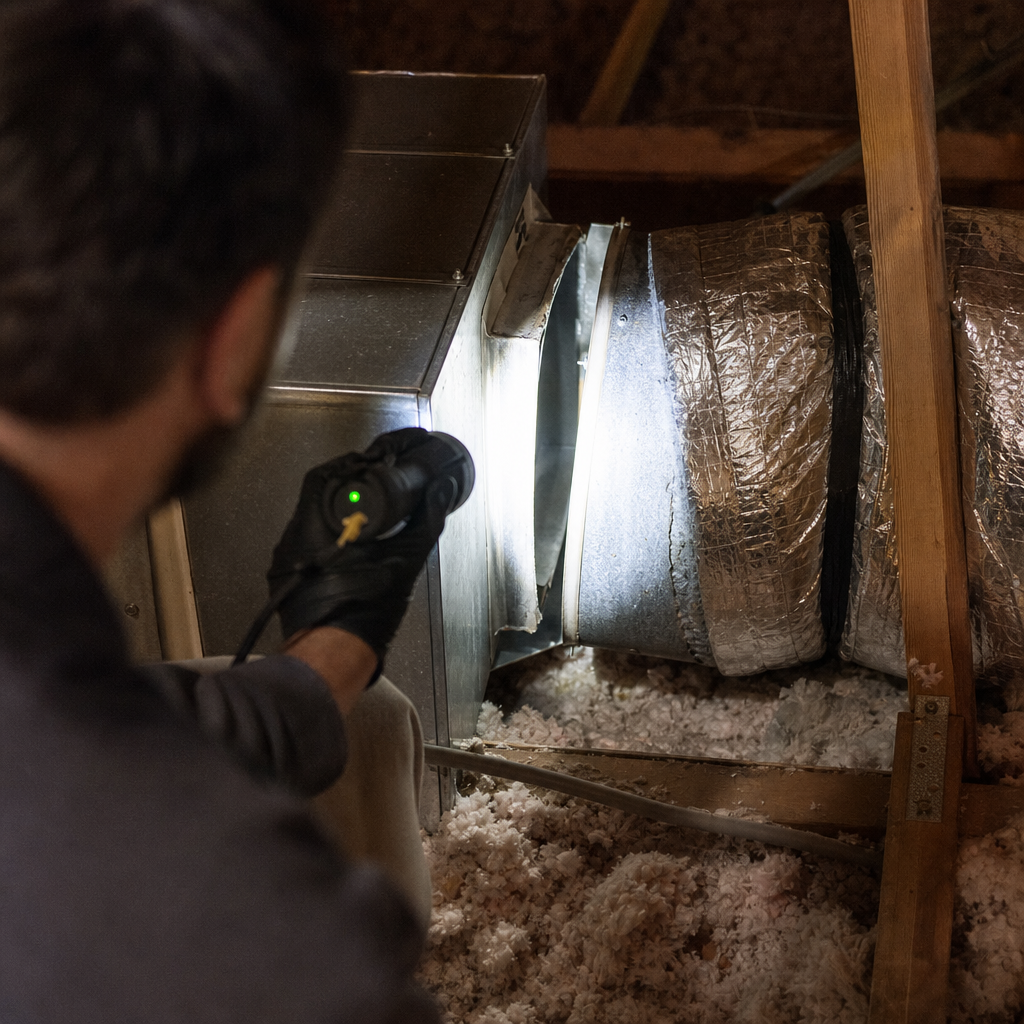
Supply ducts push air out under positive pressure, but return ducts operate under negative pressure (suction). When return plenums or duct joints have cracks or openings, that suction can draw attic air directly into your ductwork.
The negative pressure vacuum effect in attics
During hot summer weather in Burbank, attic temperatures can rise significantly. If return ductwork has open seams, the system draws unconditioned attic air directly into the air handler. This increases the thermal load on the cooling equipment and can cause the air conditioner to run longer during peak afternoon hours.
Common failure points: flex duct tears, plenum joints, and disconnected boots
As Pure Air Duct Cleaners points out, duct leaks typically develop at junction points where different components join together:
- Plenum seams: The sheet metal box attached directly to the indoor air handler can separate at the seams due to vibration and temperature changes.
- Flex duct outer jackets: Age, radiant attic heat, and past pest activity can degrade the outer vapor barrier, leading to tears in the duct material.
- Register boots: Sheet metal collars connecting registers to drywall can loosen over time, allowing wall-cavity air into the airflow stream.
Potential air quality impacts from attic particles
When negative pressure draws attic air into return ducts, it may pull in loose insulation fibers, dust, and other particulate matter found in attic spaces. In regions prone to seasonal wildfire smoke, particulate matter can accumulate in unsealed attics over time. Unfiltered particles drawn into return ducts can deposit on cooling coils and circulate through living areas.
What is the difference between manual mastic duct sealing and Aeroseal?
Need duct sealing in Burbank?
We’re available now — call for a fast, free estimate.
Manual mastic duct sealing involves applying a thick, fiber-reinforced paste by hand over accessible seams, joints, and plenum collars. Aeroseal is an automated process that seals vents and disperses an aerosolized polymer mist inside pressurized ducts. According to Pure Air Duct Cleaners, for homes with accessible attics, manual mastic provides direct sealing at mechanical joints, while aerosol sealing is designed primarily for ductwork hidden behind finished drywall.
Comparing sealing methods and accessibility
Field research on California homes indicates that unsealed residential duct systems often experience noticeable air leakage. Choosing a sealing method depends on duct accessibility and the physical condition of the system.[5]
| Feature | Manual Mastic & Mesh Tape | Aeroseal Injection | Standard Duct Tape |
|---|---|---|---|
| Application Method | Hand-brushed fiber paste | Internal aerosol mist | Pressure-sensitive adhesive |
| Best Use Case | Accessible attics and crawl spaces | Concealed wall cavities | Temporary holds only |
| Large Gap Repair | Yes (reinforced with mesh) | No (requires manual pre-patch) | No (tends to fail quickly) |
When manual mastic paste and mesh are the right choice
For Burbank homes with accessible attic or crawl space layouts, manual mastic provides distinct advantages:
- Mechanical Strength: Technicians embed fiberglass mesh tape across sheet metal joints and coat it with water-based mastic, creating a durable, flexible seal that withstands seasonal temperature shifts.
- Fixes Structural Gaps: Aerosol mist is suited for smaller seams, whereas manual sealing can bridge larger gaps around plenum collars and boots where major air loss can occur.
- Targeted Application: Manual application focuses directly on accessible problem areas without requiring specialized internal aerosol machinery.
Frequently asked questions about duct sealing in Burbank
How much does professional duct sealing cost in Burbank CA?
The cost of residential duct sealing depends on attic accessibility, the number of HVAC units, the overall size of the system, and whether any duct sections need structural repair or replacement.
What are the signs that my home HVAC ducts need sealing?
Common signs include rooms with noticeable temperature variations, dust accumulation near vents, higher seasonal utility bills, and faint odors when the system turns on.
How much energy and money can duct sealing save on utility bills?
Duct sealing can improve heating and cooling efficiency and may reduce monthly energy costs. Preventing conditioned air loss and reducing warm attic air intrusion helps the HVAC system operate more efficiently.
What is the difference between manual duct sealing and Aeroseal?
Manual sealing uses a brush-applied, fiber-reinforced mastic paste on the exterior of duct joints and plenums. Aeroseal seals ducts from the inside using pressurized aerosol particles. Manual mastic is commonly used for accessible attics and crawl spaces, while Aeroseal is typically used for ducts enclosed behind finished walls.
How long does the duct sealing process take?
As noted by Pure Air Duct Cleaners, the duration of a duct sealing project varies based on the size of the home, system accessibility, and the extent of repairs needed. Technicians inspect duct runs, secure loose connections, seal seams, and verify airflow.
Does duct sealing help reduce indoor dust and allergens?
Yes. Sealing return plenums and duct connections helps prevent HVAC systems from drawing in attic dust, loose insulation fibers, and fine outdoor particles, which can help keep indoor air cleaner and reduce filter loading.
Need duct sealing in Burbank?
We’re available now — call for a fast, free estimate.
Sources
- Duct leakage impacts on VAV system performance in California … – digital.library.unt.edu (2025)
- [PDF] Chapter 4 – Building HVAC Requirements – energy.ca.gov (2019)
- Duct leakage impacts on VAV system performance in California large commercial buildings – osti.gov (2000)
- [PDF] Duct Leakage Repeatability Testing – OSTI.GOV – osti.gov
- Sealing HVAC Ducts With Aerosol Sealant – www2.lbl.gov
Duct Sealing in Nearby Cities
We also serve the communities around Burbank:
- Duct Sealing in Los Angeles
- Duct Sealing in Beverly Hills
- Duct Sealing in Century City
- Duct Sealing in Culver City
- Duct Sealing in Echo Park
- Duct Sealing in Hollywood
- Duct Sealing in Koreatown
- Duct Sealing in North Hollywood
Frequently Asked Questions
How soon can I run my HVAC system after manual mastic duct sealing?
Water-based mastic sealant typically skins over within a few hours and fully cures within 24 to 48 hours depending on attic temperatures. Pure Air Duct Cleaners mechanically secures all joints with fiberglass mesh tape before applying mastic, allowing Burbank homeowners to safely operate their heating and cooling systems shortly after service.
How does professional duct sealing help Burbank homes meet California Title 24 standards?
California Title 24 targets duct leakage rates at or below 6% of total fan airflow for optimal efficiency. Founder Larry Torres and the Pure Air Duct Cleaners team directly target high-loss failure points – including return plenums, branch collars, and register boots – with reinforced mastic to bring residential ductwork into compliance with state tight-duct benchmarks.
What is included during an owner-led duct inspection with Pure Air Duct Cleaners?
During your free inspection, Larry Torres personally examines attic and crawl space duct runs, checking for separated plenum seams, degraded flex duct jackets, and negative-pressure return leaks. Pure Air Duct Cleaners provides an exact, transparent scope of work detailing the manual mastic repairs needed to eliminate conditioned air loss and resolve hot spots.
About the author
 |
Sarah Jenkins Sarah is a certified HVAC technician and indoor air quality specialist with over a decade of experience serving the Los Angeles area. She holds a B.S. in Environmental Science from UCLA and has dedicated her career to educating homeowners on the importance of duct maintenance and system efficiency. Her writing focuses on practical, cost-effective solutions for improving residential air quality and extending the life of HVAC systems. |
Dusty vents or weak airflow at home?
We’re available now — call for a fast, free estimate.
Call Now - Free Estimate