
Quick Summary
Leaky HVAC systems in older California homes can waste conditioned air, inflate energy bills by up to 20%, and draw attic and crawlspace dust directly into living spaces. Pure Air Duct Cleaners delivers professional duct sealing in Echo Park using commercial-grade mastic to repair disconnected joints, restore balanced airflow, and lower monthly utility costs. Readers will understand how to evaluate duct damage, compare manual mastic versus aerosol sealing methods, and schedule a free duct inspection and sealing estimate in Echo Park.
Duct Sealing in California Homes: Cut Energy Bills and Stop Dust
For homeowners seeking professional duct sealing, proper testing and sealing can eliminate hot spots and lower monthly utility costs. Research from the U.S. Department of Energy shows that sealing leaky ducts in attics and crawlspaces saves roughly 15% to 20% on heating and cooling energy. Sealing also helps prevent the circulation of attic dust, dirt, and insulation fibers throughout living spaces.[4]
In older California and Los Angeles homes, including Craftsman bungalows and mid-century hillside properties, aging ductwork often features shifted joints and cracked plenums. Professional sealing services from Pure Air Duct Cleaners apply commercial-grade mastic sealants to restore airflow balance and joint integrity, helping protect indoor comfort and lower utility bills.
Quick Summary
Quick answer: Professional duct sealing repairs disconnected joints, torn flex ducts, and leaking plenums so conditioned air stays inside your living space instead of escaping into attics or crawlspaces. Research from the U.S. Department of Energy shows that proper sealing saves roughly 15% to 20% on heating and cooling energy, helps balance room temperatures, and reduces the entry of unconditioned air and dust into living areas.
Professional sealing stops treated air from escaping in older California architecture. In homes with unsealed return plenums, pressure imbalances can draw unconditioned air and settled dust from attics or crawlspaces. Data from the U.S. Department of Energy indicates that sealing ducts located in attics or crawlspaces can save about 15% to 20% on heating and cooling energy. Technicians resolve these pressure imbalances using mastic sealants and airflow diagnostics.
What Does Professional Duct Sealing Cost?
Duct sealing costs generally vary based on duct accessibility, the size of the HVAC system, and the overall condition of the ductwork. Residential project costs depend on factors such as system layout and sub-floor accessibility.
Key Factors Influencing Your Estimate
Several practical factors determine the total cost of HVAC duct sealing:
- Sub-Floor and Crawlspace Accessibility: Steep hillside foundations and narrow crawlspaces require extra setup and labor to reach distribution runs safely.
- Condition of the Ductwork: Aging flex lines or cracked sheet metal plenums require mechanical patching before sealant can be applied.
- System Size and Layout: Multi-zone systems or sprawling floor plans require additional materials, diagnostic testing, and labor hours.
As statewide context, studies by the American Council for an Energy-Efficient Economy show that residential duct leakage in California homes has averaged 7.7% of total fan flow, above the 6% tight-duct standard. Correcting this delivers notable gains. Research from Lawrence Berkeley National Laboratory shows that proper duct sealing can reduce peak electricity demand by more than 25% in warm climates.[1]
How Duct Leakage Affects Airflow in Older California Homes
Need duct sealing in Echo Park?
We’re available now — call for a fast, free estimate.
Duct leakage does more than let conditioned air escape; it can create pressure imbalances. When return ducts and plenums have gaps, the HVAC blower can create negative pressure inside the duct, drawing unconditioned air and dust from crawlspaces or attics into living areas.
Airflow Dynamics in Crawlspaces
In older California homes with raised foundations, HVAC ducts often run through crawlspaces. When return ductwork develops gaps or disconnected boots, the system can draw air directly from unconditioned spaces beneath the home. As statewide context, California Title 24 building standards have required duct leakage testing and sealing since 2001 to improve system efficiency. Without proper sealing, duct systems can circulate unconditioned air while increasing energy consumption.[2]
Contaminants and Unconditioned Air
Unsealed crawlspace ductwork can draw unconditioned air and particulate matter into living spaces, including:
- Crawlspace air and damp odors
- Soil particulate, dust, and degrading insulation fibers
- Outdoor airborne particulate that settles in unconditioned spaces
Diagnostic airflow evaluations from Pure Air Duct Cleaners help locate return plenum leaks, seal unconditioned crawlspace penetrations, and balance airflow throughout the home.
Manual Mastic Sealing vs. Aeroseal: What Is the Difference?
The main difference between manual mastic sealing and Aeroseal is how the sealant is applied. Manual sealing applies a thick, fiber-reinforced paste directly to the exterior joints of accessible ducts, while Aeroseal uses an aerosol mist pressurized inside the duct system to fill leaks hidden behind finished drywall.
Manual Hand-Applied Mastic
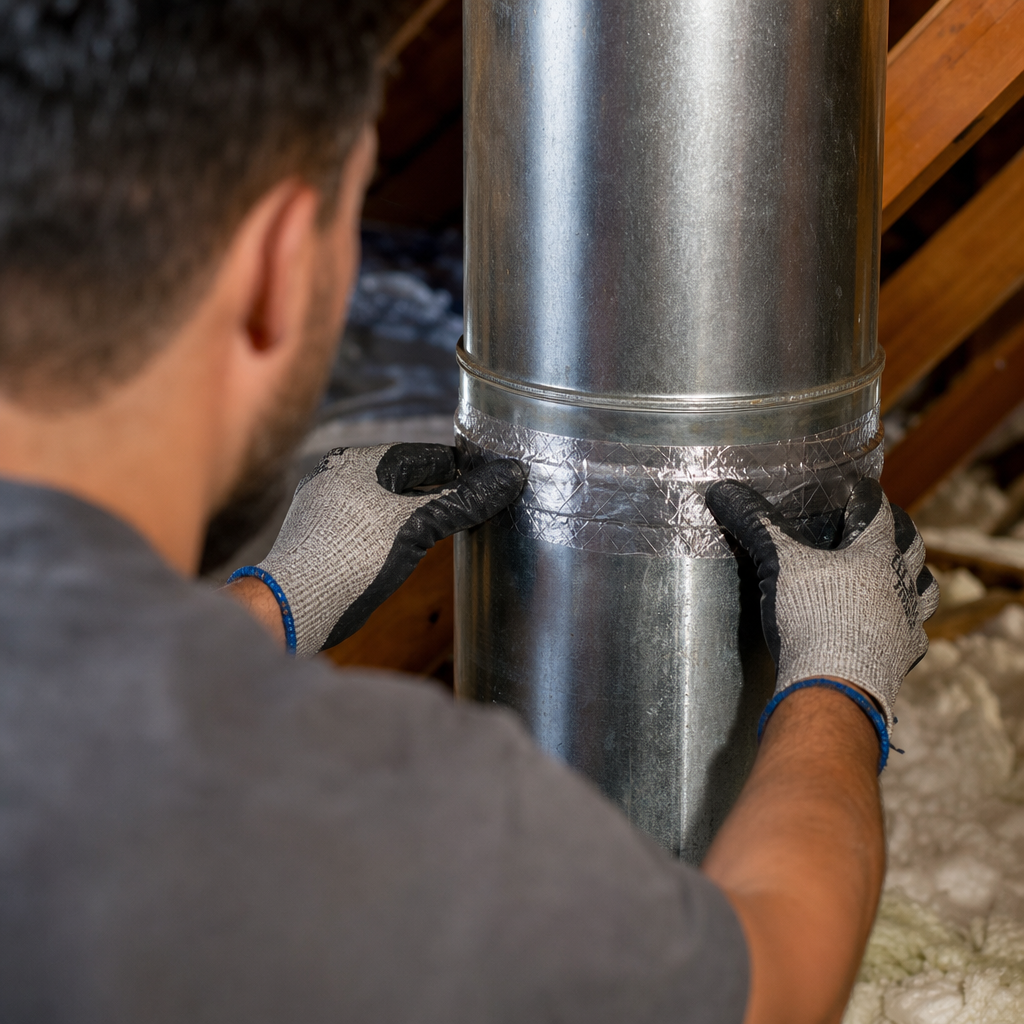
Manual mastic sealing is a standard approach for accessible ductwork in attics, basements, and open crawlspaces. Technicians at Pure Air Duct Cleaners apply a thick, durable compound reinforced with fiberglass mesh tape over all seams, collars, and sheet metal plenums. Once cured, it forms a flexible seal that will not crack or dry out like standard duct tape.
Aerosol-Based Internal Duct Sealing
Aerosol duct sealing involves blocking supply and return registers, then injecting pressurized sealant particles into the duct network. The adhesive particles stick to the edges of hidden leaks inside wall cavities, building up until gaps are sealed without needing to open walls.
Choosing the Right Approach for Your Home
Research from the American Council for an Energy-Efficient Economy showed that duct sealing reduced leakage flow by roughly 40% and lowered overall heating and cooling energy use by around 10% in test homes. Manual mastic sealing provides a durable, long-term repair for accessible ductwork and plenums.[3]
When to Repair vs. Replace HVAC Ducts
According to Pure Air Duct Cleaners, HVAC ducts only require targeted repair and sealing when rigid sheet metal, collars, and plenums are structurally intact. Full replacement is usually necessary only when flexible ducting has completely collapsed, suffered physical damage, or experienced severe mold colonization.
Assessing Ductwork Condition
Flexible duct runs can degrade over time from attic heat cycles, age, and physical strain. Common problems include detached boot collars, torn outer vapor barriers, and collapsed inner cores.
| Ductwork Condition | Recommended Action |
|---|---|
| Separated joints, unsealed seams, or leaking sheet metal plenums | Manual mastic repair, mesh tape, and mechanical screws |
| Crushed flex runs, torn inner liners, or heavy physical deterioration | Targeted duct section replacement and proper hanging support |
Why Targeted Sealing Usually Solves the Problem
According to Lawrence Berkeley National Laboratory retrofit analyses, single-family detached homes in California energy programs achieved a median 75% reduction in total duct leakage through targeted sealing alone. Most comfort issues and high electric bills can be resolved with precise joint sealing rather than replacing the entire duct network.[5]
Frequently Asked Questions About Duct Sealing
Here are answers to common questions about repairing and sealing HVAC ductwork.
How long does an air duct sealing service take?
As Pure Air Duct Cleaners notes, most single-family homes typically take several hours to test and seal, depending on crawlspace accessibility, attic access, and the total number of supply and return vents.
Can duct sealing reduce dust indoors?
Yes. Sealing duct joints closes gaps where return ducts can pull in unconditioned crawlspace air, attic insulation fibers, and dust, helping keep indoor air cleaner.
Does sealing air ducts lower energy bills?
Yes. Research from the U.S. Department of Energy shows that sealing leaky ducts in attics and crawlspaces saves roughly 15% to 20% on heating and cooling energy, allowing HVAC equipment to operate more efficiently and reducing monthly utility costs.
Need duct sealing in Echo Park?
We’re available now — call for a fast, free estimate.
Sources
- Measure Guideline: Sealing and Insulating of Ducts in … – www1.eere.energy.gov (2011)
- Remote Duct Sealing in Residential and Commercial … – energy.gov (2005)
- [PDF] Field Test of Advanced Duct-Sealing Technologies within the … – huduser.gov (2001)
- Sealing HVAC Ducts With Aerosol Sealant – www2.lbl.gov
- Microsoft Word – AIVC_Workshop_Paper_Chan (3).doc – eta-publications.lbl.gov
Duct Sealing in Nearby Cities
We also serve the communities around Echo Park:
- Duct Sealing in Los Angeles
- Duct Sealing in Beverly Hills
- Duct Sealing in Burbank
- Duct Sealing in Century City
- Duct Sealing in Culver City
- Duct Sealing in Hollywood
- Duct Sealing in Koreatown
- Duct Sealing in North Hollywood
Frequently Asked Questions
How is duct sealing performed in Echo Park hillside homes with difficult crawlspace access?
Pure Air Duct Cleaners navigates steep foundations and narrow sub-floors typical of Echo Park properties using specialized diagnostic tools to reach tight distribution runs. Technicians mechanically secure disconnected collars and apply fiber-reinforced mastic to permanently isolate living spaces from unconditioned crawlspace air.
How long does professional mastic duct sealant last compared to standard tape?
Unlike standard duct tape that degrades quickly under intense California attic heat cycles, commercial-grade mastic forms a permanent, flexible bond reinforced with fiberglass mesh. Pure Air Duct Cleaners applies durable mastic compounds engineered to last for decades without cracking, drying out, or peeling.
How do technicians verify that duct leakage has been eliminated after sealing?
Airflow diagnostic testing evaluates system pressure before and after the repair to confirm duct leakage meets or exceeds California Title 24 efficiency targets. Pure Air Duct Cleaners measures supply and return airflow to ensure conditioned air reaches living spaces instead of escaping into attics or crawlspaces.
About the author
 |
Sarah Jenkins Sarah is a certified HVAC technician and indoor air quality specialist with over a decade of experience serving the Los Angeles area. She holds a B.S. in Environmental Science from UCLA and has dedicated her career to educating homeowners on the importance of duct maintenance and system efficiency. Her writing focuses on practical, cost-effective solutions for improving residential air quality and extending the life of HVAC systems. |
Dusty vents or weak airflow at home?
We’re available now — call for a fast, free estimate.
Call Now - Free Estimate