
Quick Summary
Echo Park residences face unique indoor air challenges due to vintage architecture, hillside terrain, and urban pollutants that generalized outdoor AQI readings cannot measure. Pure Air Duct Cleaners explains that professional indoor air quality testing must be pollutant-specific, targeting mold spores, VOCs, and particulate matter alongside physical inspections to uncover contamination sources. Readers will understand testing factors and costs, enabling them to contact Pure Air Duct Cleaners for a comprehensive indoor air assessment and targeted remediation estimate.
Indoor Air Quality Testing in Echo Park: How Safe Is Your Air?
Echo Park features varied residential architecture, from vintage bungalows and hillside properties to modern apartment buildings. In general, living in hilly terrain or older homes can introduce environmental considerations. When smoke, urban smog, or musty smells settle into a living space, residents often consider indoor air quality testing to evaluate their indoor environment.[2]
A study from Harvard’s Healthy Buildings program analyzed indoor air-quality data from 1,048 Los Angeles-area homes using 1,578 monitors during the 2025 wildfire period and did not separately identify Echo Park. Furthermore, no authoritative publicly available dataset in the provided sources reports indoor air-quality testing results specifically for Echo Park, and available data does not establish an Echo Park-specific safety rating or indoor air-quality average. Outdoor Air Quality Index (AQI) readings describe outdoor conditions and should not be presented as indoor testing results, nor should regional Los Angeles findings or outdoor neighborhood AQI readings be used as evidence that a particular Echo Park home is safe or unsafe. According to Pure Air Duct Cleaners, evaluating an individual residence requires testing tailored to that specific property.[1]
Quick Answer
Quick answer in brief: Professional indoor air quality testing is pollutant-specific rather than a universal assessment. Depending on the suspected problem, testing can target parameters such as particulate matter, airborne mold indicators, volatile organic compounds (VOCs), carbon monoxide, carbon dioxide, radon, and humidity. Outdoor AQI readings describe outdoor conditions and cannot determine what is present indoors. Air sampling measures airborne particles at a given time, but it does not by itself locate the source of growth or prove causation; a physical inspection is necessary to identify underlying issues.[4]
What Pollutants Does a Home Air Quality Test Check For?
Need indoor air quality testing in Echo Park?
We’re available now — call for a fast, free estimate.
An indoor air quality assessment is not a single, universal assessment. Instead, testing is pollutant-specific, with diagnostic targets and sampling methods selected according to the suspected problem, property characteristics, and occupant concerns.[3]
Fine Particulate Matter (PM2.5 and PM10)
Particulate matter consists of microscopic solid particles and liquid droplets suspended in the air. In hillside areas or near major roadway corridors, vehicle emissions, dust, and seasonal smoke can contribute to outdoor particulate concentrations. Laser particle counters measure concentrations of PM2.5 (fine inhalable particles) and PM10 (coarse dust) to help evaluate particulate penetration through building envelopes or indoor accumulation.
Mold Spores and Biological Contaminants
Older structures and hillside homes may experience moisture accumulation in subfloors, crawlspaces, or wall assemblies following rain events. Air sampling uses calibrated pumps to collect airborne particles on spore traps from indoor living areas and compares them against outdoor baseline controls. While air sampling measures airborne particles, including fungal spores and fragments, it does not by itself locate active mold growth or prove causation. Pinpointing the actual source or surface growth requires physical inspection, moisture mapping, or direct surface sampling.
Volatile Organic Compounds (VOCs) and Chemical Off-Gassing
VOCs are chemical vapors released by everyday building materials, fresh interior paint, floor finishes, cabinetry, adhesives, and household cleaning products. Photoionization detectors (PIDs) or laboratory canisters measure VOC concentrations to check for chemical off-gassing, which can occur in renovated spaces that lack balanced mechanical ventilation.
Combustion Byproducts and Ventilation Gases
Heating setups and gas appliances can release combustion gases if equipment is malfunctioning or improperly vented. Depending on the suspected issue, testing may evaluate:
- Carbon Monoxide (CO): A dangerous, odorless gas produced by incomplete combustion in aging or malfunctioning furnaces, wall heaters, or gas appliances.
- Carbon Dioxide (CO2): An indicator of overall ventilation efficiency and fresh air exchange in occupied spaces.
- Relative Humidity: Monitoring humidity levels helps assess indoor moisture conditions that may contribute to respiratory discomfort or microbial growth.
- Radon: A naturally occurring radioactive soil gas that can enter living areas through foundation openings or unsealed crawlspaces.
Evaluating Air Quality in Older and Hillside Architecture
As Pure Air Duct Cleaners observes, older homes and hillside properties often have architectural characteristics that influence air pathways. For instance, historic properties that originally used gravity heating systems may retain unlined cavities or abandoned chases from previous HVAC conversions.
Over time, unsealed wall cavities and legacy chases can collect dust and settled debris, which may circulate through living areas when air systems operate. In addition, localized terrain and temperature inversions can trap vehicle exhaust and smoke in low-lying pockets, allowing outdoor pollutants to enter older homes with drafty window frames or unsealed subfloors.
When Should You Schedule an Air Quality Assessment?
Routine air testing on a fixed calendar schedule is rarely necessary. Diagnostic testing is typically performed when specific triggers appear:
- Unexplained Health Symptoms: Occupants experience persistent congestion, eye irritation, sinus flare-ups, or headaches that ease when leaving the residence.
- Musty or Chemical Odors: Lingering smells that cannot be traced to an obvious surface stain, suggesting hidden dampness or off-gassing materials.
- Post-Renovation Verification: Confirming that dust barriers and containment measures successfully limited the spread of construction dust during a remodel.
- Real Estate Purchases: Evaluating older properties with deferred maintenance, previous water staining, or unvented crawlspaces.
- Recent Water Leaks: Assessing indoor living areas following plumbing failures, roof leaks, or localized water intrusion.
How Much Does Indoor Air Quality Testing Cost?
Need indoor air quality testing in Echo Park?
We’re available now — call for a fast, free estimate.
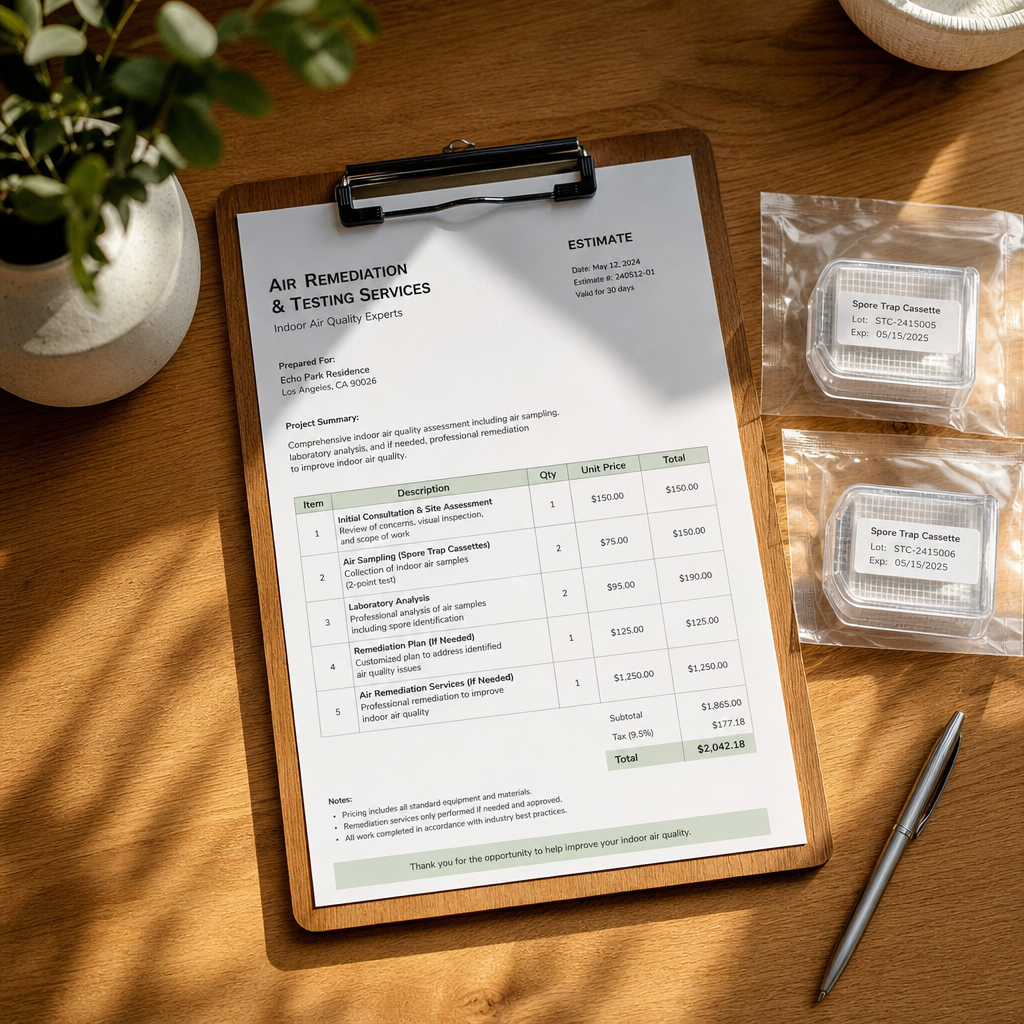
The cost of an air quality assessment depends entirely on the scope of testing required. A basic investigation using direct-read instruments for specific parameters generally costs less than a project requiring accredited third-party laboratory analysis.
Key factors that shape the overall price include:
- Laboratory Samples: Each spore trap cassette, surface lift, or VOC canister sent to an environmental lab adds individual analytical fees.
- Property Size and Layout: Multi-story residences, separate living units, or complex HVAC layouts require multiple sampling locations and baseline controls.
- Diagnostic Equipment Used: Assessments requiring specialized instruments, such as thermal imaging devices, particle counters, or PID sensors, require additional technician time.
- Reporting Depth: Comprehensive written reports with detailed data interpretation and remediation guidance involve more preparation time than basic summaries.
The Difference Between Testing, Remediation, and Duct Cleaning
Testing provides diagnostic data; it does not remediate physical problems. A diagnostic air test measures specific airborne pollutants, but it does not remove them or automatically indicate that air ducts require cleaning.
EPA evidence does not show that routine duct cleaning reliably improves indoor air quality or prevents health problems. As Pure Air Duct Cleaners explains, condition-specific cleaning decisions require physical evidence and professional evaluation, such as confirmed substantial mold growth inside duct systems, vermin infestation, or significant debris restricting airflow. If elevated particulate or spore levels are detected, the priority is identifying and correcting the underlying source before pursuing mechanical cleaning.
Frequently Asked Questions
How much does indoor air quality testing cost in Echo Park?
Costs vary based on the specific pollutants evaluated, the number of samples collected, and whether third-party laboratory analysis is required. Basic direct-read assessments typically cost less than investigations involving multiple lab-analyzed samples or comprehensive reports.
What does a home indoor air quality test check for?
Testing is pollutant-specific rather than a fixed package. Assessments are customized to evaluate relevant targets based on the property and suspected issues, which may include fine particulate matter (PM2.5 and PM10), mold-related indicators, VOCs, carbon monoxide, carbon dioxide, radon, or relative humidity.
How do I know if my home needs air quality testing?
Testing is generally considered when occupants experience unexplained respiratory symptoms that improve away from the home, persistent musty or chemical odors, visible signs of unmanaged moisture, or following major renovations.
Can air duct cleaning improve indoor air quality test results?
EPA evidence does not indicate that routine duct cleaning reliably improves indoor air quality. Cleaning may be warranted when professional evaluation reveals physical evidence of heavy debris, pest infestation, or confirmed microbial growth within the ductwork, but addressing underlying sources such as moisture intrusion remains the primary step.
How long does a professional air quality assessment take?
The duration of an on-site inspection and the turnaround time for laboratory results are variable. On-site assessment time depends on property size and testing scope, while laboratory processing times vary according to the specific analytical methods and protocols requested.
Does air quality testing detect mold spores and VOCs?
Testing can measure airborne mold spores and chemical VOC concentrations when those specific diagnostics are selected. However, air sampling measures airborne particles and does not by itself locate physical mold growth or prove causation; physical inspection is required to identify the source.
Need indoor air quality testing in Echo Park?
We’re available now — call for a fast, free estimate.
Sources
- Indoor air quality in 1,000 homes in L.A. before and during … – healthybuildings.hsph.harvard.edu (2025)
- Indoor Air Quality – healthybuildings.hsph.harvard.edu (2025)
- Air Pollution in Los Angeles County – publichealth.lacounty.gov
- Indoor Air Quality | US EPA – epa.gov
Indoor Air Quality Testing in Nearby Cities
We also serve the communities around Echo Park:
- Indoor Air Quality Testing in Los Angeles
- Indoor Air Quality Testing in Beverly Hills
- Indoor Air Quality Testing in Burbank
- Indoor Air Quality Testing in Century City
- Indoor Air Quality Testing in Culver City
Frequently Asked Questions
What steps should I take if my Echo Park air quality test shows elevated contaminants?
Once testing identifies elevated mold spores, VOCs, or particulate matter, the immediate priority is locating and resolving the underlying source through a physical inspection. Pure Air Duct Cleaners can then evaluate your ventilation pathways and recommend targeted remediation, such as duct sanitization and high-efficiency filtration upgrades.
How do vintage home layouts in Echo Park affect indoor air pathways?
Historic bungalows and hillside homes often retain unlined chases, converted gravity heating cavities, and unsealed subfloors that accumulate decades of settled debris. Pure Air Duct Cleaners inspects these architectural air pathways to pinpoint hidden contamination sources that standard living area tests might not isolate.
Can consumer air monitors replace professional indoor air quality testing?
Consumer devices offer helpful real-time estimates for basic particulate matter and humidity, but they cannot identify specific mold species, laboratory-grade VOCs, or hidden HVAC issues. Professional diagnostic testing from Pure Air Duct Cleaners combines calibrated pollutant sampling with a physical structural inspection to deliver actionable findings.
About the author
 |
Sarah Jenkins Sarah is a certified HVAC technician and indoor air quality specialist with over a decade of experience serving the Los Angeles area. She holds a B.S. in Environmental Science from UCLA and has dedicated her career to educating homeowners on the importance of duct maintenance and system efficiency. Her writing focuses on practical, cost-effective solutions for improving residential air quality and extending the life of HVAC systems. |
Dusty vents or weak airflow at home?
We’re available now — call for a fast, free estimate.
Call Now - Free Estimate