
Quick Summary
Professional indoor air quality testing in Hollywood evaluates hidden airborne contaminants, mold spores, volatile chemical vapors, and ventilation efficiency that regional outdoor monitors fail to capture. Expert diagnostic assessments from Pure Air Duct Cleaners combine direct-reading instruments, physical HVAC inspections, and calibrated laboratory sampling to identify the root environmental sources behind property air concerns. Property owners will learn what testing entails and how to schedule an on-site indoor air assessment with Pure Air Duct Cleaners to receive a free, upfront diagnostic estimate.
Indoor Air Quality Testing in Hollywood: Overview and Testing Methods
Indoor air quality testing helps property owners evaluate airborne contaminants, assess building ventilation, and investigate environmental concerns. Diagnostic testing identifies measurable substances in the air and helps locate potential source areas. Available research does not identify an authoritative Hollywood-specific statistic on how many buildings or homes receive indoor air quality testing.[3]
Regional outdoor figures do not reflect what you breathe inside. While an independent data publisher reported a 2024 annual outdoor PM2.5 mean of 13 micrograms per cubic meter and 98.4% of days with an AQI below 100 for the area, those estimates rely on the nearest Los Angeles monitoring station roughly 5.7 miles away. On-site indoor air testing provides direct data on specific living spaces, and professional assessments, such as those conducted by Pure Air Duct Cleaners, may include inspection or sampling of crawlspaces and duct networks when relevant.[5]
What Does Indoor Air Quality Testing in Hollywood Involve?
Quick answer: Professional testing evaluates targeted airborne pollutants, which may include fine particulate matter (PM2.5 and PM10), volatile organic compounds (VOCs), mold spores, carbon monoxide, carbon dioxide, and allergens. According to published general estimates, on-site assessments generally take between 2 and 5 hours, while laboratory analysis typically takes 3 to 7 business days, though turnaround times vary by test and specialized mold or VOC analyses may take longer.
A diagnostic visit typically follows a systematic process, with specific methods selected based on the scope of work:
- Environmental screening: Depending on the scope, technicians may use direct-reading instruments such as laser particle counters, photoionization detectors (PIDs) for VOCs, and digital meters to check real-time particulate levels, chemical vapors, relative humidity, and temperature.
- Physical source inspection: When relevant, professionals may inspect components such as supply registers, return plenums, blower wheels, evaporator coils, attics, and subfloor crawlspaces for indicators of moisture intrusion, microbial growth, or damaged duct insulation.
- Active sample collection: Sampling methods may include collecting calibrated cassette air samples, surface lift tapes, or thermal desorption tubes for laboratory analysis when biological agents or chemical off-gassing require precise identification.
What Does an Indoor Air Quality Test Check For?
No single test measures every possible pollutant. Sampling plans should reflect the building’s physical layout, occupant concerns, and visible environmental indicators. California’s Department of Public Health Indoor Air Quality Program studies indoor pollutants, concentrations, exposure durations, exposure routes, and health effects through field studies, human-exposure studies, epidemiological studies, literature reviews, and laboratory experiments to understand these complex exposure pathways.[4]
Outdoor infiltration and environmental dynamics
Outdoor air pollutants can infiltrate indoor spaces based on local atmospheric conditions, pressure differentials, and building envelope characteristics. Dynamic testing measures air quality in the breathing zone while heating, ventilation, and air conditioning (HVAC) systems operate under typical pressure differentials.
HVAC mechanical condition and air-cleaning performance
Evaluating heating and cooling equipment helps determine how effectively a system filters or circulates air. In research reviewed by the California Air Resources Board, four tested air-cleaning systems reduced indoor particulate matter originating from outdoor air by more than 90%, though this finding does not predict performance in every property. As specialists at Pure Air Duct Cleaners note, testing assesses whether filtration setups and airflow perform properly for a given space.[2]
Building age and structural considerations
Building characteristics and ventilation design can influence indoor air quality:
- Older residential buildings: Properties may feature unsealed subfloor areas or aging duct runs that can contribute to indoor air concerns if moisture or dust accumulates.
- Modern, tightly sealed construction: Energy-efficient retrofits and newer builds restrict natural air exchange. According to California workplace indoor-air guidance, measuring carbon dioxide is recommended when occupants describe rooms as stuffy, close, or stifling, helping determine if fresh outdoor ventilation rates meet baseline occupancy demands.
What Does Indoor Air Quality Testing and Remediation Cost?
Need indoor air quality testing in Hollywood?
We’re available now — call for a fast, free estimate.
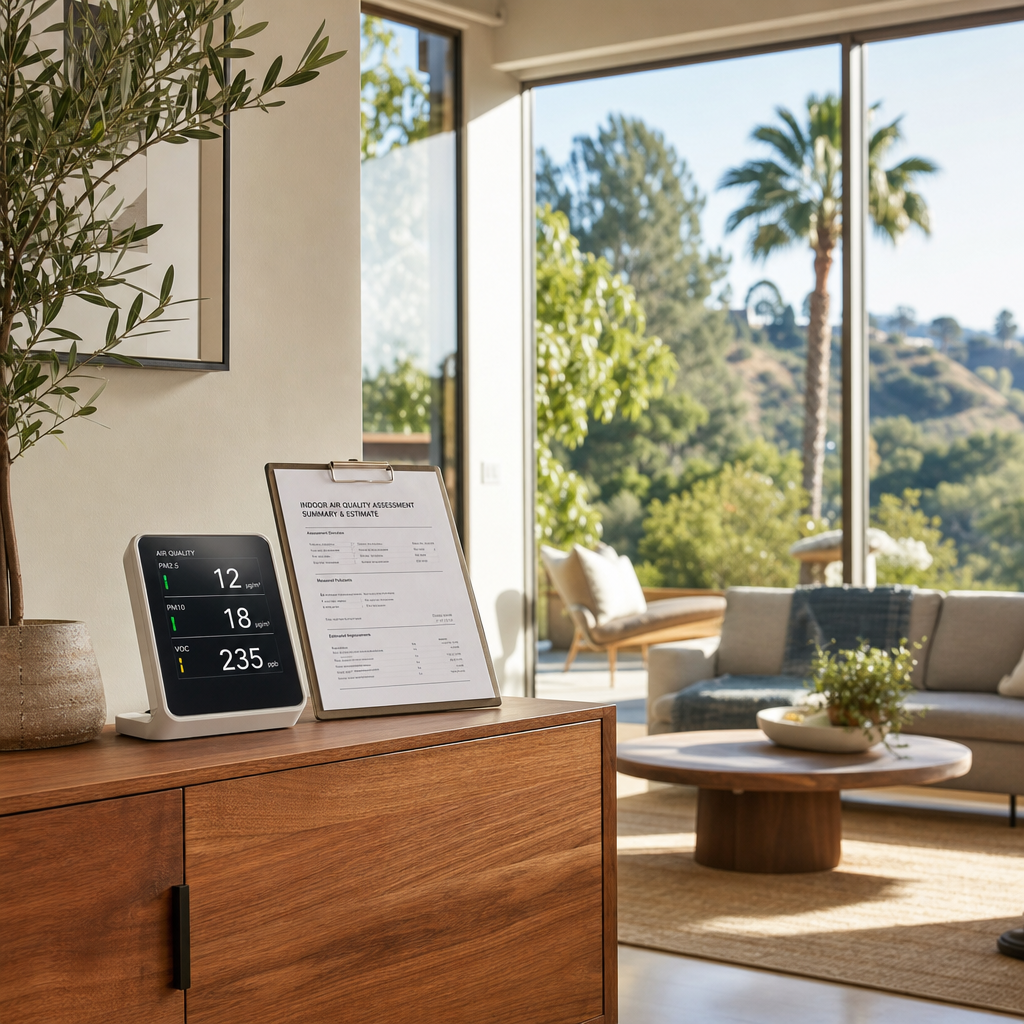
Costs depend on property square footage, the total number of indoor and outdoor baseline samples collected, and the depth of laboratory analysis required. A basic baseline screening with direct-read instruments costs significantly less than an investigation requiring multiple spore-trap cassettes, volatile chemical chromatography, and physical material sampling.
Key factors determining testing and corrective costs
- System layout and zones: Multi-split systems, dual-zone packages, or sprawling ductwork networks require multiple test points across different living zones to isolate problem areas.
- Physical accessibility: Tight attic spaces, complex roof packages, and restricted subfloor access require extra labor time during physical inspections.
- Laboratory analytical panels: Standard optical microscopy for fungal spores carries different lab fees than gas chromatography-mass spectrometry (GC-MS) panels used for solvent or chemical identification.
- Turnaround requirements: According to published general estimates, standard laboratory turnarounds run 3 to 7 business days, though times vary by test, and rush processing incurs additional lab surcharges.
In a California Air Resources Board community project, researchers planned to assess filtration effectiveness in 100 homes with a 15% indoor-air-quality improvement target; this project was not Hollywood-specific. Identifying specific underlying causes is an essential step before proceeding with corrective measures.
Can HVAC Duct Cleaning Improve Air Quality Test Results?
Duct cleaning may remove adhered dust and dirt from duct surfaces; however, evidence reviewed by the U.S. Environmental Protection Agency (EPA) did not establish that duct cleaning reliably reduces indoor pollutants, bioaerosols, or microbial density.
Addressing settled duct debris
While mechanical cleaning of accessible duct lines by services like Pure Air Duct Cleaners can remove accumulated debris, it does not necessarily resolve underlying air quality problems if sources of contamination remain active.
Source control and environmental assessment
Long-term air quality depends primarily on source control. State guidance notes that bioaerosol sampling should generally be performed when physical evidence indicates a source or when occupants have a medical condition suggesting a building source. Resolving moisture issues, sealing building envelope gaps, and verifying conditions with objective testing address root environmental causes.[1]
Frequently Asked Questions
How long does testing take, and what equipment may be used?
According to published general estimates, technicians complete on-site physical diagnostics and direct-read testing within 2 to 5 hours, while laboratory analysis of air cassettes, tape lifts, and VOC tubes generally requires 3 to 7 business days, though turnaround times vary by test and specialized mold or VOC analyses may take longer. Depending on the scope of the assessment, equipment examples include calibrated air sampling pumps, optical particle counters, photoionization detectors, thermal imaging cameras, and moisture meters.
When is professional indoor air quality testing typically considered?
Professional testing may be considered when there is physical evidence of mold or moisture intrusion, lingering odors, ventilation concerns, or when occupants have a medical condition suggesting a building source.
Need indoor air quality testing in Hollywood?
We’re available now — call for a fast, free estimate.
Sources
- Carbon dioxide guidelines for indoor air quality: a review – pubmed.ncbi.nlm.nih.gov (2024)
- Indoor Air Quality Research – California Air Resources Board – ww2.arb.ca.gov (2018)
- Indoor Air Quality | US EPA – epa.gov
- Indoor Air Quality (IAQ) Section – cdph.ca.gov
- [PDF] SOUTH COAST AIR QUALITY MANAGEMENT DISTRICT – AQMD – aqmd.gov
Indoor Air Quality Testing in Nearby Cities
We also serve the communities around Hollywood:
- Indoor Air Quality Testing in Los Angeles
- Indoor Air Quality Testing in Beverly Hills
- Indoor Air Quality Testing in Burbank
- Indoor Air Quality Testing in Century City
- Indoor Air Quality Testing in Culver City
Frequently Asked Questions
How should I prepare my property before an indoor air quality inspection?
To ensure accurate baseline readings, keep exterior windows and doors closed for 12 to 24 hours before your appointment and run your HVAC system normally. Avoid burning candles, using aerosol sprays, or cleaning with harsh chemical solvents immediately prior to testing so diagnostic instruments measure true everyday conditions.
What happens after Pure Air Duct Cleaners delivers my diagnostic lab report?
Once laboratory analysis identifies specific airborne contaminants and particulate levels, Pure Air Duct Cleaners reviews the detailed findings with you to pinpoint root contamination sources. From there, our specialists provide a clear, upfront remediation plan that addresses active moisture issues, ventilation shortfalls, and necessary mechanical duct improvements.
Can indoor air quality testing detect lingering wildfire smoke residues indoors?
Yes, professional testing uses laser particle counters and calibrated sampling to measure fine particulate matter (PM2.5) and chemical combustion markers associated with regional wildfire infiltration. Pure Air Duct Cleaners evaluates your HVAC filtration efficiency and ductwork to determine if outdoor smoke particles have compromised indoor breathing zones.
About the author
 |
Sarah Jenkins Sarah is a certified HVAC technician and indoor air quality specialist with over a decade of experience serving the Los Angeles area. She holds a B.S. in Environmental Science from UCLA and has dedicated her career to educating homeowners on the importance of duct maintenance and system efficiency. Her writing focuses on practical, cost-effective solutions for improving residential air quality and extending the life of HVAC systems. |
Dusty vents or weak airflow at home?
We’re available now — call for a fast, free estimate.
Call Now - Free Estimate