
Quick Summary
Leaky HVAC ductwork pulls in attic particulates and causes severe energy loss, making professional duct sealing in Studio City essential for maintaining balanced airflow and clean indoor air. Pure Air Duct Cleaners delivers owner-operated inspections alongside manual mastic and aerosol applications to resolve air leaks permanently at transparent, upfront rates. Readers will learn how to identify damaged duct systems and can schedule a free on-site duct inspection and sealing estimate to reduce utility bills.
Duct Sealing in Studio City: Lower Energy Bills and Stop Dust at the Source
If your AC struggles during summer heatwaves or dust coats your furniture right after cleaning, leaky ductwork is often the culprit. When attic ducts pull apart or crack, your HVAC system can pull hot attic air, dust, and outdoor particulates directly into your bedrooms and living spaces. Pure Air Duct Cleaners repairs and seals ductwork across the San Fernando Valley to restore proper airflow, improve energy efficiency, and protect indoor air quality.[5]
In general, residential duct sealing project costs depend on duct accessibility, home size, and whether repairs require manual mastic paste or aerosol applications. Owner Larry Torres inspects every system on-site, providing honest assessments and mechanical sealing methods to address duct leakage.[4]
What Professional Duct Sealing Involves
Professional duct sealing addresses the points where conditioned air escapes and unconditioned air enters: supply plenums, return drop boxes, flex-duct junctions, and register boots. Instead of applying standard tape, a technician from Pure Air Duct Cleaners uses mastic sealant or aerosol methods designed to reduce air leakage.
California energy standards set a target of keeping residential duct leakage at or below 6% of total fan airflow. General HVAC field studies frequently find that unsealed duct systems can lose a significant portion of their conditioned air. A proper sealing service systematically addresses these leakage areas:[1]
- Airflow and pressure inspection: Locating tears, disconnected runs, and pressure imbalances across trunk lines and junction boxes.
- Manual mastic application: Coating sheet metal seams and collar connections with fiber-reinforced mastic sealant to seal gaps.
- Boot and register sealing: Sealing the gaps between ceiling drywall and metal register boots to prevent unconditioned attic air from entering rooms.
- Post-repair verification: Testing static pressure and register output to ensure balanced airflow throughout the home.
Cost of Duct Sealing
Duct sealing costs depend on the physical layout of your attic or crawlspace, the number of HVAC zones, and the condition of the existing duct material. General industry price ranges include:
| Service Type | Estimated Cost | Scope of Work |
|---|---|---|
| Targeted Boot and Register Sealing | $250 – $450 | Seals gaps between drywall and duct boots across accessible registers |
| Full Manual Mastic Sealing | $500 – $1,200 | Seals plenums, flex-duct collars, split seams, and distribution boxes |
| Combined Duct Cleaning and Sealing | $650 – $1,500 | Mechanical cleaning of supply and return trunks paired with mastic sealing |
Tight crawlspaces, multi-level homes with buried duct chases, and heavily damaged insulation can influence project timing and labor. Sealing duct leaks can reduce cooling waste and lower utility costs; for example, one Department of Energy study found that duct sealing saved about $80 per year in Phoenix. For an itemized quote based on your specific setup, schedule an on-site evaluation with Pure Air Duct Cleaners.[2]
Why Leaky Ducts Hurt Air Quality and System Performance
Need duct sealing in Studio City?
We’re available now — call for a fast, free estimate.
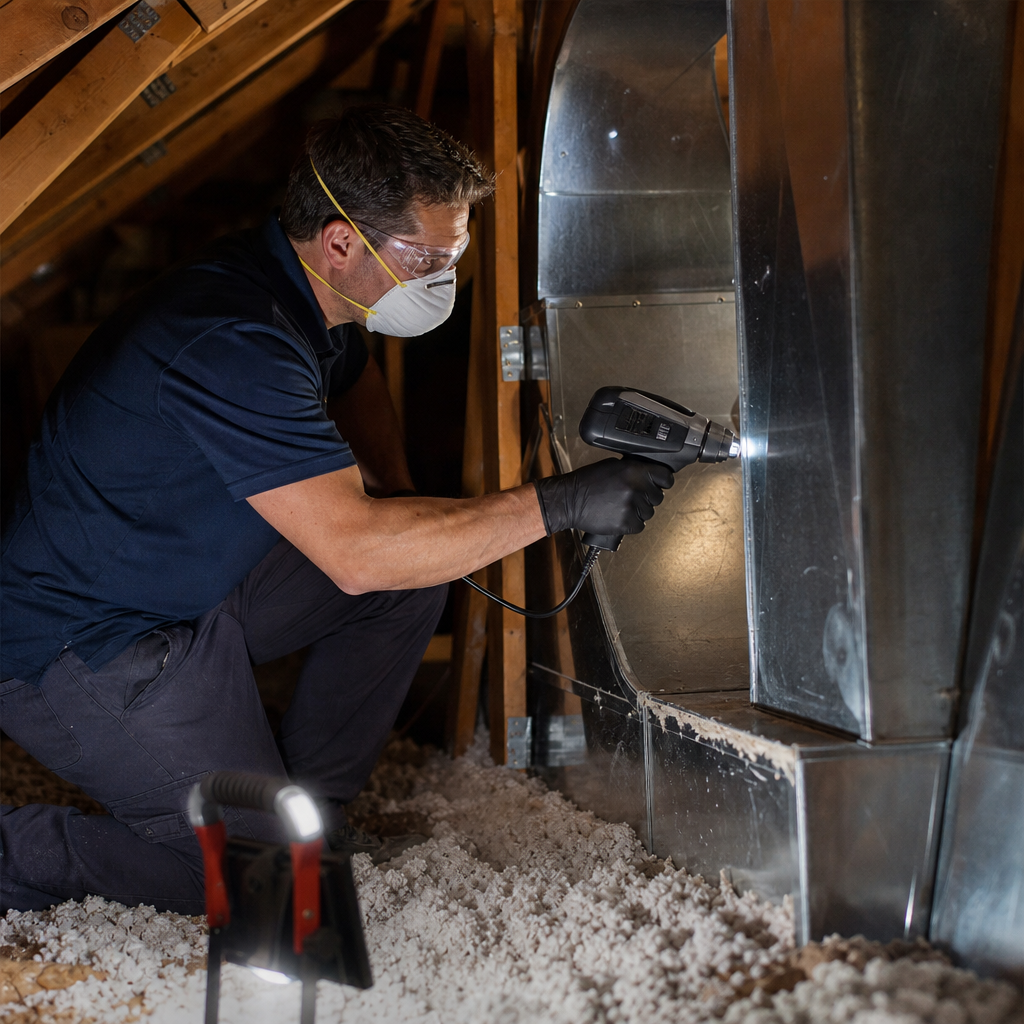
When supply ducts leak air into an unconditioned attic, the house loses pressure. That lost air is replaced by unconditioned air drawn through window cracks, can lights, and wall cavities. Leaks on the return side can also pull unconditioned attic air directly into the air handler, bypassing the filtration system.[3]
Attic Dust and Insulation Fibers
Attics can reach high temperatures and accumulate particulate matter, including insulation fibers and household dust. Return plenum leaks draw these particles into the central air stream, circulating them through living spaces when the fan operates.
Uneven Room Temperatures and High Utility Bills
If your system pushes conditioned air that escapes into the attic through disconnected runs or seams, distant rooms may struggle to reach the thermostat setting. The system runs longer cycles trying to compensate, which can increase electric bills and add wear to HVAC components.
Common Signs Your Ducts Need Attention
- Rapid dust accumulation: Noticeable dust settling quickly on surfaces after cleaning.
- Musty or attic odors: A warm, dusty, or stale smell when the system turns on.
- Weak register airflow: Uneven airflow across different rooms in the home.
- Rising electric bills: Higher energy bills despite normal daily thermostat settings.
Manual Mastic Sealing vs. Aeroseal Technology
Both manual mastic paste and aerosol-based sealing methods are used to reduce duct leakage, depending on ductwork accessibility.
| Feature | Manual Mastic Sealing | Aeroseal Aerosol Sealing | Standard Duct Tape |
|---|---|---|---|
| Best For | Accessible attics, basements, and plenums | Concealed duct chases behind finished drywall | Temporary repairs only |
| Leakage Reduction | Reduces leakage at joints and seams | Reduces leakage across small gaps internally | Limited leakage reduction |
| Application Method | Applied by hand with brush or trowel | Injected as an aerosol through duct system | Applied by hand over joints |
| Physical Access | Requires direct hands-on access | Injected through service ports | Requires direct hands-on access |
Manual Mastic and Mesh
Manual sealing uses a water-based mastic compound, often reinforced with fiberglass mesh tape over larger seams. Mastic is commonly used to seal accessible attic ductwork, supply plenums, and mechanical connections to reduce air leakage.
Aerosol Internal Sealing
When ducts run between floors or through finished walls where direct access is limited, aerosol sealing pressurizes the duct network and introduces aerosolized sealant particles. These particles accumulate at the edges of leaks and openings, sealing air gaps from inside the ductwork.
Frequently Asked Questions
How is manual mastic duct sealing used?
Manual mastic sealant is applied over duct joints, collars, and seams to create a durable seal that reduces air loss and prevents unconditioned air from entering the duct system.
Can sealing my ducts help indoor air quality?
Yes. Sealing helps prevent duct leaks from pulling attic dust, insulation particles, and outdoor airborne matter into the ventilation stream. When paired with effective air filters, sealed ducts support cleaner indoor air.
How do I know if my system needs cleaning before sealing?
If significant dust, pet hair, or debris is present in your duct branches, cleaning the ducts before sealing prevents contaminants from remaining trapped inside the system. During an inspection, the technician from Pure Air Duct Cleaners evaluates internal buildup and recommends whether cleaning prior to sealing is appropriate.
How do I schedule an inspection in Studio City?
Pure Air Duct Cleaners is fully licensed, bonded, and insured. Contact our team to book an on-site duct inspection with owner Larry Torres to assess your home’s duct system.
Need duct sealing in Studio City?
We’re available now — call for a fast, free estimate.
Sources
- Microsoft Word – LBNL-175563rev2.docx – eta-publications.lbl.gov (2013)
- Berkeley Lab Duct Sealing Innovation Saves Energy in Buildings … – ipo.lbl.gov (2003)
- Building America Best Practices Series, Vol. 10 – Energy.gov – www1.eere.energy.gov (2009)
- Measure Guideline: Sealing and Insulating of Ducts in … – www1.eere.energy.gov (2011)
- Remote Duct Sealing in Residential and Commercial … – energy.gov
Duct Sealing in Nearby Cities
We also serve the communities around Studio City:
- Duct Sealing in Los Angeles
- Duct Sealing in Beverly Hills
- Duct Sealing in Burbank
- Duct Sealing in Century City
- Duct Sealing in Culver City
- Duct Sealing in Echo Park
- Duct Sealing in Hollywood
- Duct Sealing in Koreatown
Frequently Asked Questions
How long does professional duct sealing take for a typical home?
A standard residential duct sealing project usually takes between two to five hours, depending on attic accessibility and the overall scope of repairs. Pure Air Duct Cleaners performs comprehensive pre- and post-repair airflow testing within this timeframe to verify results without disrupting your daily routine.
How long does manual mastic duct sealing last in hot attic conditions?
Fiber-reinforced mastic creates a permanent, flexible bond that typically lasts 15 to 20 years, often outlasting the flexible ductwork itself. Pure Air Duct Cleaners uses commercial-grade mastic that resists cracking, drying out, or degrading under intense San Fernando Valley attic heat.
How quickly will I notice cleaner air and lower energy bills after sealing?
You will notice more balanced airflow and a significant reduction in airborne dust almost immediately after the HVAC system is turned back on. Energy bill savings typically appear on your next billing cycle because your air conditioner no longer needs to run extended cycles to compensate for lost air.
About the author
 |
Sarah Jenkins Sarah is a certified HVAC technician and indoor air quality specialist with over a decade of experience serving the Los Angeles area. She holds a B.S. in Environmental Science from UCLA and has dedicated her career to educating homeowners on the importance of duct maintenance and system efficiency. Her writing focuses on practical, cost-effective solutions for improving residential air quality and extending the life of HVAC systems. |
Dusty vents or weak airflow at home?
We’re available now — call for a fast, free estimate.
Call Now - Free Estimate